

Beacon Press
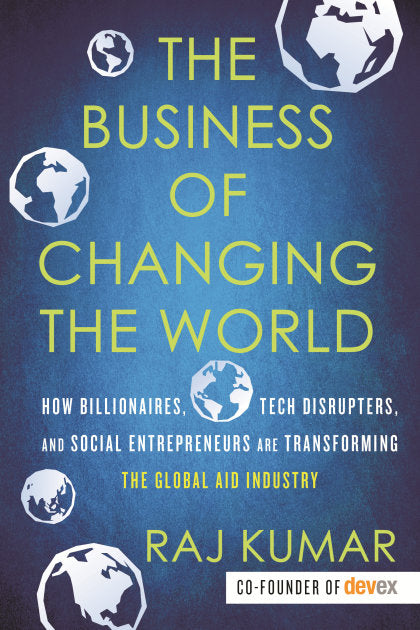
The Business of Changing the World
The Business of Changing the World
Couldn't load pickup availability
Collapsible content
ABOUT
Drawing on 2 decades covering global development as editor in chief of Devex, Raj Kumar explores how nontraditional models of philanthropy and aid are empowering the world’s poorest people to make progress. Old aid was driven by good intentions and relied on big-budget projects from a few government aid agencies, like the World Bank and USAID. Today, corporations, Silicon Valley start-ups, and billionaire philanthropists are a disrupting force pushing global aid to be data driven and results oriented. This $200 billion industry includes emerging and established foundations like the Chan Zuckerberg Initiative and the Bill and Melinda Gates Foundation. Entrepreneurial startups like Hello Tractor, which offers an Uber-like app for farmers in Nigeria, and Give Directly, whose app allows individuals to send money straight to the phone of someone in need, are also giving rise to this new culture of charity. The result is a more sustainable philosophy of aid that elevates the voices of the world’s poor as neighbors, partners, and customers.
Refreshing and accessibly written, The Business of Changing the World sets forth a bold vision for how we can use our vote, our voice, and our wallet to turn well-intentioned charity into effective advocacy to transform the world for good. Businesspeople, policymakers, entrepreneurs, nonprofit executives, philanthropists, and aid workers around the world will all be influenced by this transformation.
STANDARD, PRIMARY, DM AND VARIANT COVERS
Standard and Primary covers are widely available through general retailers. They often have higher print runs and can be cheaper, especially during sales.
In contrast, Direct Market (DM) and variant covers are primarily sold in comic shops. DM editions tend to have more limited availability and may be more valuable to collectors.
The main differences lie in artwork style, availability, price, and collector appeal. Ultimately, the choice between standard and variant covers depends on personal preference, budget, and individual collecting goals.
PRODUCT TYPES
Comic book enthusiasts have various formats to choose from when collecting their favorite stories.
Here's a brief overview of the main types:
Omnibus
- Large, hardcover collections
- Usually contain complete runs or extensive story arcs
- Typically 800-1000+ pages
- Higher price point, often €100-€150
Oversized Hardcover (OHC)
- Similar dimensions to omnibus, but thinner
- Collect shorter runs or story arcs
- Usually 300-600 pages
- Priced between €30-€50
Hardcover (HC)
- Standard-sized hardcover books
- Collect 6-12 issues typically
- Similar dimensions to single issues, but with a hard cover
- Priced around €25-€35
Trade Paperback (TP)
- Softcover collections
- Standard comic book size
- Usually collect 4-6 issues
- Most affordable option, typically €15-€25
Other Formats
- Absolute Editions: Oversized, deluxe hardcovers (mainly DC Comics)
- Compendiums: Massive paperback collections
- Graphic Novels (OGN/GN): Original stories not previously released as single issues
The choice between these formats often depends on personal preference, budget, and collecting goals. Omnibus and OHC editions offer larger artwork and more content but at a higher price, while TPs provide a more affordable way to collect complete story arcs