

Crown
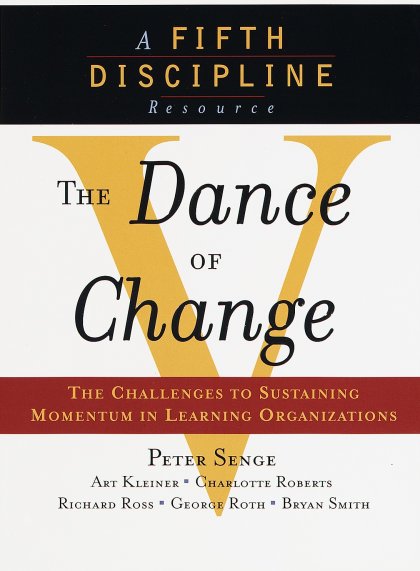
The Dance of Change
The Dance of Change
Couldn't load pickup availability
Collapsible content
ABOUT
Now, drawing upon new theories about leadership and the long-term success of change initiatives, and based upon twenty-five years
of experience building learning organizations, the authors of The Fifth Discipline Fieldbook show how to accelerate success and avoid the obstacles that can stall momentum. The Dance of Change, written for managers and executives at every level of an organization, reveals how business leaders can work together to anticipate the challenges that profound change will ultimately force the organization to face. Then, in a down-to-earth and compellingly clear format, readers will learn how to build the personal and organizational capabilities needed to meet those challenges.
These challenges are not imposed from the outside; they are the product of assumptions and practices that people take for granted—an inherent, natural part of the processes of change. And they can stop innovation cold, unless managers at all levels learn to anticipate them and recognize the hidden rewards in each challenge, and the potential to spur further growth. Within the frequently encountered challenge of "Not Enough Time," for example—the lack of control over time available for innovation and learning initiatives—lies a valuable opportunity to reframe the way people organize their workplaces.
This book identifies universal challenges that organizations ultimately find themselves confronting, including the challenge of "Fear and Anxiety"; the need to diffuse learning across organizational boundaries; the ways in which assumptions built in to corporate measurement systems can handcuff learning initiatives; and the almost unavoidable misunderstandings between "true believers" and nonbelievers in a company.
Filled with individual and team exercises, in-depth accounts of sustaining learning initiatives by managers and leaders in the field, and well-tested practical advice, The Dance of Change provides an insider's perspective on implementing learning and change initiatives at such corporations as British Petroleum, Chrysler, Dupont, Ford, General Electric, Harley-Davidson, Hewlett-Packard, Mitsubishi Electric, Royal DutchShell, Shell Oil Company, Toyota, the United States Army, and Xerox. It offers crucial advice for line-level managers, executive leaders, internal networkers, educators, and others who are struggling to put change initiatives into practice.
STANDARD, PRIMARY, DM AND VARIANT COVERS
Standard and Primary covers are widely available through general retailers. They often have higher print runs and can be cheaper, especially during sales.
In contrast, Direct Market (DM) and variant covers are primarily sold in comic shops. DM editions tend to have more limited availability and may be more valuable to collectors.
The main differences lie in artwork style, availability, price, and collector appeal. Ultimately, the choice between standard and variant covers depends on personal preference, budget, and individual collecting goals.
PRODUCT TYPES
Comic book enthusiasts have various formats to choose from when collecting their favorite stories.
Here's a brief overview of the main types:
Omnibus
- Large, hardcover collections
- Usually contain complete runs or extensive story arcs
- Typically 800-1000+ pages
- Higher price point, often €100-€150
Oversized Hardcover (OHC)
- Similar dimensions to omnibus, but thinner
- Collect shorter runs or story arcs
- Usually 300-600 pages
- Priced between €30-€50
Hardcover (HC)
- Standard-sized hardcover books
- Collect 6-12 issues typically
- Similar dimensions to single issues, but with a hard cover
- Priced around €25-€35
Trade Paperback (TP)
- Softcover collections
- Standard comic book size
- Usually collect 4-6 issues
- Most affordable option, typically €15-€25
Other Formats
- Absolute Editions: Oversized, deluxe hardcovers (mainly DC Comics)
- Compendiums: Massive paperback collections
- Graphic Novels (OGN/GN): Original stories not previously released as single issues
The choice between these formats often depends on personal preference, budget, and collecting goals. Omnibus and OHC editions offer larger artwork and more content but at a higher price, while TPs provide a more affordable way to collect complete story arcs