

Library of America
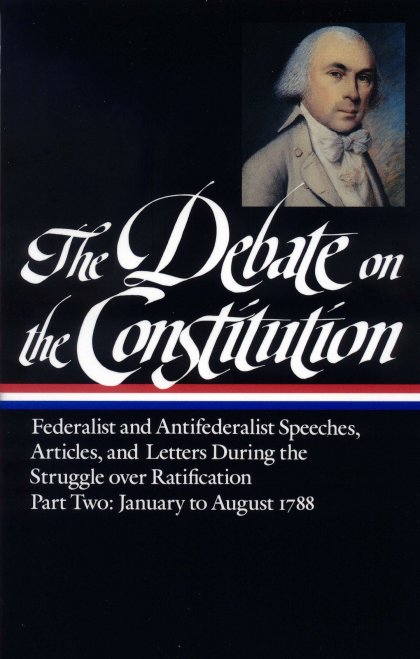
The Debate on the Constitution: Federalist and Antifederalist Speeches, Articles, and Letters During the Struggle over Ratification Vol. 2 (LOA #63)
The Debate on the Constitution: Federalist and Antifederalist Speeches, Articles, and Letters During the Struggle over Ratification Vol. 2 (LOA #63)
Couldn't load pickup availability
Collapsible content
ABOUT
Assembled here in chronological order are hundreds of newspaper articles, pamphlets, speeches, and private letters written or delivered in the aftermath of the Constitutional Convention. Along with familiar figures like Franklin, Madison, Patrick Henry, Jefferson, and Washington, scores of less famous citizens are represented, all speaking clearly and passionately about government. The most famous writings of the ratification struggle — the Federalist essays of Hamilton and Madison — are placed in their original context, alongside the arguments of able antagonists, such as "Brutus" and the "Federal Farmer."
Part Two gathers collected press polemics and private commentaries from January to August 1788, including all the amendments proposed by state ratifying conventions as well as dozens of speeches from the South Carolina, Virginia, New York, and North Carolina conventions. Included are dramatic confrontations from Virginia, where Patrick Henry pitted his legendary oratorical skills against the persuasive logic of Madison, and from New York, where Alexander Hamilton faced the brilliant Antifederalist Melancton Smith.
Informative notes, biographical profiles of all writers, speakers, and recipients, and a detailed chronology of relevant events from 1774 to 1804 provide fascinating background. A general index allows readers to follow specific topics, and an appendix includes the Declaration of Independence, the Articles of Confederation, and the Constitution (with all amendments).
LIBRARY OF AMERICA is an independent nonprofit cultural organization founded in 1979 to preserve our nation’s literary heritage by publishing, and keeping permanently in print, America’s best and most significant writing. The Library of America series includes more than 300 volumes to date, authoritative editions that average 1,000 pages in length, feature cloth covers, sewn bindings, and ribbon markers, and are printed on premium acid-free paper that will last for centuries.
STANDARD, PRIMARY, DM AND VARIANT COVERS
Standard and Primary covers are widely available through general retailers. They often have higher print runs and can be cheaper, especially during sales.
In contrast, Direct Market (DM) and variant covers are primarily sold in comic shops. DM editions tend to have more limited availability and may be more valuable to collectors.
The main differences lie in artwork style, availability, price, and collector appeal. Ultimately, the choice between standard and variant covers depends on personal preference, budget, and individual collecting goals.
PRODUCT TYPES
Comic book enthusiasts have various formats to choose from when collecting their favorite stories.
Here's a brief overview of the main types:
Omnibus
- Large, hardcover collections
- Usually contain complete runs or extensive story arcs
- Typically 800-1000+ pages
- Higher price point, often €100-€150
Oversized Hardcover (OHC)
- Similar dimensions to omnibus, but thinner
- Collect shorter runs or story arcs
- Usually 300-600 pages
- Priced between €30-€50
Hardcover (HC)
- Standard-sized hardcover books
- Collect 6-12 issues typically
- Similar dimensions to single issues, but with a hard cover
- Priced around €25-€35
Trade Paperback (TP)
- Softcover collections
- Standard comic book size
- Usually collect 4-6 issues
- Most affordable option, typically €15-€25
Other Formats
- Absolute Editions: Oversized, deluxe hardcovers (mainly DC Comics)
- Compendiums: Massive paperback collections
- Graphic Novels (OGN/GN): Original stories not previously released as single issues
The choice between these formats often depends on personal preference, budget, and collecting goals. Omnibus and OHC editions offer larger artwork and more content but at a higher price, while TPs provide a more affordable way to collect complete story arcs