

Random House Publishing Group
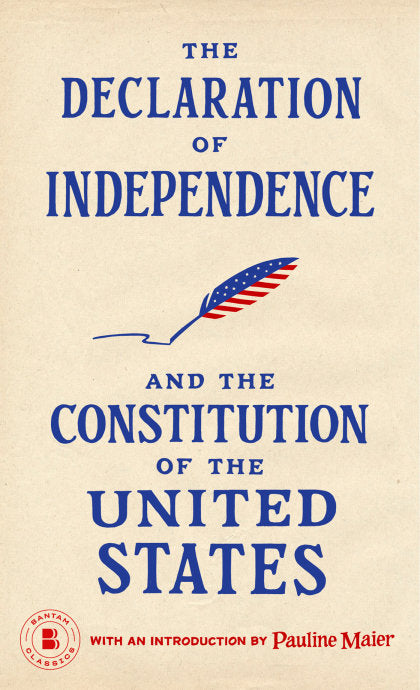
The Declaration of Independence and The Constitution of the United States
The Declaration of Independence and The Constitution of the United States
Couldn't load pickup availability
Collapsible content
ABOUT
With an introduction by Pauline Maier, a renowned scholar of the American Revolution.
The Declaration of Independence was the promise of a representative government; the Constitution was the fulfillment of that promise.
On July 4, 1776, the Second Continental Congress issued a unanimous declaration: the thirteen North American colonies would be the thirteen United States of America, free and independent of Great Britain. Drafted by Thomas Jefferson, the Declaration set forth the terms of a new form of government with the following words: “We hold these Truths to be self-evident, that all men are created equal, that they are endowed with certain unalienable Rights, that among these are Life, Liberty, and the Pursuit of Happiness.”
Framed in 1787 and in effect since March 1789, the Constitution of the United States of America fulfilled the promise of the Declaration by establishing a republican form of government with separate executive, legislative, and judicial branches. The first ten amendments, known as the Bill of Rights, became part of the Constitution on December 15, 1791. Among the rights guaranteed by these amendments are freedom of speech, freedom of the press, freedom of religion, and the right to trial by jury. Written so that it could be adapted to endure for years to come, the Constitution has been amended only seventeen times since 1791 and has lasted longer than any other written form of government.
STANDARD, PRIMARY, DM AND VARIANT COVERS
Standard and Primary covers are widely available through general retailers. They often have higher print runs and can be cheaper, especially during sales.
In contrast, Direct Market (DM) and variant covers are primarily sold in comic shops. DM editions tend to have more limited availability and may be more valuable to collectors.
The main differences lie in artwork style, availability, price, and collector appeal. Ultimately, the choice between standard and variant covers depends on personal preference, budget, and individual collecting goals.
PRODUCT TYPES
Comic book enthusiasts have various formats to choose from when collecting their favorite stories.
Here's a brief overview of the main types:
Omnibus
- Large, hardcover collections
- Usually contain complete runs or extensive story arcs
- Typically 800-1000+ pages
- Higher price point, often €100-€150
Oversized Hardcover (OHC)
- Similar dimensions to omnibus, but thinner
- Collect shorter runs or story arcs
- Usually 300-600 pages
- Priced between €30-€50
Hardcover (HC)
- Standard-sized hardcover books
- Collect 6-12 issues typically
- Similar dimensions to single issues, but with a hard cover
- Priced around €25-€35
Trade Paperback (TP)
- Softcover collections
- Standard comic book size
- Usually collect 4-6 issues
- Most affordable option, typically €15-€25
Other Formats
- Absolute Editions: Oversized, deluxe hardcovers (mainly DC Comics)
- Compendiums: Massive paperback collections
- Graphic Novels (OGN/GN): Original stories not previously released as single issues
The choice between these formats often depends on personal preference, budget, and collecting goals. Omnibus and OHC editions offer larger artwork and more content but at a higher price, while TPs provide a more affordable way to collect complete story arcs