

Crown
The Devil's Tickets
The Devil's Tickets
Couldn't load pickup availability
Collapsible content
ABOUT
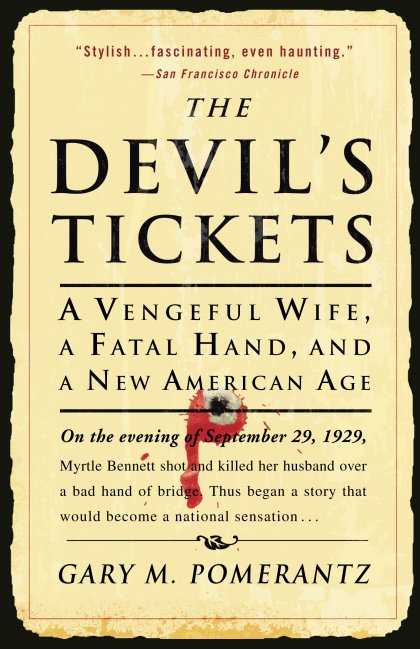
in hand, Myrtle fires four shots, killing her husband.
The Roaring 1920s inspired nationwide fads–flagpole sitting, marathon dancing, swimming-pool endurance floating. But of all the mad games that cheered Americans between the wars, the least likely was contract bridge. As the Barnum of the bridge craze, Ely Culbertson, a tuxedoed boulevardier with a Russian accent, used mystique, brilliance, and a certain madness to transform bridge from a social pastime into a cultural movement that made him rich and famous. In writings, in lectures, and on the radio, he used the Bennett killing to dramatize bridge as the battle of the sexes. Indeed, Myrtle Bennett’s murder trial became a sensation because it brought a beautiful housewife–and hints of her husband’s infidelity–from the bridge table into the national spotlight. James A. Reed, Myrtle’s high-powered lawyer and onetime Democratic presidential candidate, delivered soaring, tear-filled courtroom orations. As Reed waxed on about the sanctity of womanhood, he was secretly conducting an extramarital romance with a feminist trailblazer who lived next door.
To the public, bridge symbolized tossing aside the ideals of the Puritans–who referred derisively to playing cards as “the Devil’s tickets”–and embracing the modern age. Ina time when such fearless women as Amelia Earhart, Dorothy Parker, and Marlene Dietrich were exalted for their boldness, Culbertson positioned his game as a challenge to all housebound women. At the bridge table, he insisted, a woman could be her husband’s equal, and more. In the gathering darkness of the Depression, Culbertson leveraged his own ballyhoo and naughty innuendo for all it was worth, maneuvering himself and his brilliant wife, Jo, his favorite bridge partner, into a media spectacle dubbed the Bridge Battle of the Century.
Through these larger-than-life characters and the timeless partnership game they played, The Devil’s Tickets captures a uniquely colorful age and a tension in marriage that is eternal.
STANDARD, PRIMARY, DM AND VARIANT COVERS
Standard and Primary covers are widely available through general retailers. They often have higher print runs and can be cheaper, especially during sales.
In contrast, Direct Market (DM) and variant covers are primarily sold in comic shops. DM editions tend to have more limited availability and may be more valuable to collectors.
The main differences lie in artwork style, availability, price, and collector appeal. Ultimately, the choice between standard and variant covers depends on personal preference, budget, and individual collecting goals.
PRODUCT TYPES
Comic book enthusiasts have various formats to choose from when collecting their favorite stories.
Here's a brief overview of the main types:
Omnibus
- Large, hardcover collections
- Usually contain complete runs or extensive story arcs
- Typically 800-1000+ pages
- Higher price point, often €100-€150
Oversized Hardcover (OHC)
- Similar dimensions to omnibus, but thinner
- Collect shorter runs or story arcs
- Usually 300-600 pages
- Priced between €30-€50
Hardcover (HC)
- Standard-sized hardcover books
- Collect 6-12 issues typically
- Similar dimensions to single issues, but with a hard cover
- Priced around €25-€35
Trade Paperback (TP)
- Softcover collections
- Standard comic book size
- Usually collect 4-6 issues
- Most affordable option, typically €15-€25
Other Formats
- Absolute Editions: Oversized, deluxe hardcovers (mainly DC Comics)
- Compendiums: Massive paperback collections
- Graphic Novels (OGN/GN): Original stories not previously released as single issues
The choice between these formats often depends on personal preference, budget, and collecting goals. Omnibus and OHC editions offer larger artwork and more content but at a higher price, while TPs provide a more affordable way to collect complete story arcs