

Random House Publishing Group
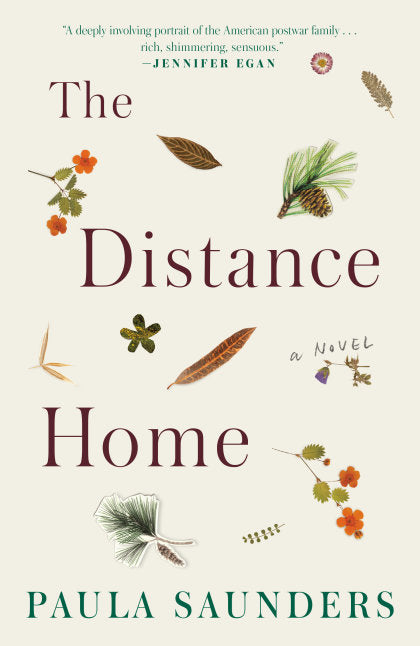
The Distance Home
The Distance Home
Couldn't load pickup availability
Collapsible content
ABOUT
NAMED ONE OF THE BEST BOOKS OF THE YEAR BY REAL SIMPLE
“A deeply involving portrait of the American postwar family” (Jennifer Egan) about sibling rivalry, dark secrets, and a young girl’s struggle with freedom and artistic desire
In the years after World War II, the bleak yet beautiful plains of South Dakota still embody all the contradictions—the ruggedness and the promise—of the old frontier. This is a place where you can eat strawberries from wild vines, where lightning reveals a boundless horizon, where descendants of white settlers and native Indians continue to collide, and where, for most, there are limited options.
René shares a home, a family, and a passion for dance with her older brother, Leon. Yet for all they have in common, their lives are on remarkably different paths. In contrast to René, a born spitfire, Leon is a gentle soul. The only boy in their ballet class, Leon silently endures often brutal teasing. Meanwhile, René excels at everything she touches, basking in the delighted gaze of their father, whom Leon seems to disappoint no matter how hard he tries.
As the years pass, René and Leon’s parents fight with increasing frequency—and ferocity. Their father—a cattle broker—spends more time on the road, his sporadic homecomings both yearned for and dreaded by the children. And as René and Leon grow up, they grow apart. They grasp whatever they can to stay afloat—a word of praise, a grandmother’s outstretched hand, the seductive attention of a stranger—as René works to save herself, crossing the border into a larger, more hopeful world, while Leon embarks on a path of despair and self-destruction.
Tender, searing, and unforgettable, The Distance Home is a profoundly American story spanning decades—a tale of haves and have-nots, of how our ideas of winning and losing, success and failure, lead us inevitably into various problems with empathy and caring for one another. It’s a portrait of beauty and brutality in which the author’s compassionate narration allows us to sympathize, in turn, with everyone involved.
“A riveting family saga for the ages . . . one of the best books I’ve read in years.”—Mary Karr
“Saunders’ debut is an exquisite, searing portrait of family and of people coping with whatever life throws at them while trying to keep close to one another.”—Booklist (starred review)
STANDARD, PRIMARY, DM AND VARIANT COVERS
Standard and Primary covers are widely available through general retailers. They often have higher print runs and can be cheaper, especially during sales.
In contrast, Direct Market (DM) and variant covers are primarily sold in comic shops. DM editions tend to have more limited availability and may be more valuable to collectors.
The main differences lie in artwork style, availability, price, and collector appeal. Ultimately, the choice between standard and variant covers depends on personal preference, budget, and individual collecting goals.
PRODUCT TYPES
Comic book enthusiasts have various formats to choose from when collecting their favorite stories.
Here's a brief overview of the main types:
Omnibus
- Large, hardcover collections
- Usually contain complete runs or extensive story arcs
- Typically 800-1000+ pages
- Higher price point, often €100-€150
Oversized Hardcover (OHC)
- Similar dimensions to omnibus, but thinner
- Collect shorter runs or story arcs
- Usually 300-600 pages
- Priced between €30-€50
Hardcover (HC)
- Standard-sized hardcover books
- Collect 6-12 issues typically
- Similar dimensions to single issues, but with a hard cover
- Priced around €25-€35
Trade Paperback (TP)
- Softcover collections
- Standard comic book size
- Usually collect 4-6 issues
- Most affordable option, typically €15-€25
Other Formats
- Absolute Editions: Oversized, deluxe hardcovers (mainly DC Comics)
- Compendiums: Massive paperback collections
- Graphic Novels (OGN/GN): Original stories not previously released as single issues
The choice between these formats often depends on personal preference, budget, and collecting goals. Omnibus and OHC editions offer larger artwork and more content but at a higher price, while TPs provide a more affordable way to collect complete story arcs