

Penguin Publishing Group
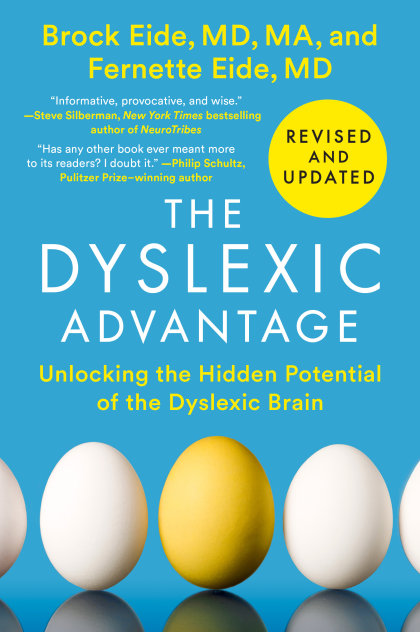
The Dyslexic Advantage (Revised and Updated)
The Dyslexic Advantage (Revised and Updated)
Couldn't load pickup availability
Collapsible content
ABOUT
What if we viewed dyslexia as a learning and processing style rather than as a learning disorder?
Drs. Brock and Fernette Eide use their impressive backgrounds in neurology and education to debunk the standard deficit-based approach to dyslexia. People typically define “dyslexia” as a reading and spelling disorder. But through published research studies, clinical observations, and interviews with dyslexic individuals, the Eides prove that these challenges are not dyslexia’s main features but are instead trade-offs resulting from an entirely different pattern of brain organization and information processing that has powerful advantages. For example, dyslexic adults routinely outperform their non-dyslexic peers in studies on three-dimensional spatial reasoning and divergent creativity—one of the reasons why so many dyslexics are successful engineers. Approximately 20 percent of the U.S. population has dyslexia, and The Dyslexic Advantage shows how each one is predisposed to powerful skills called MIND strengths (Material, Interconnected, Narrative, and Dynamic Reasoning), leading them to possess incredible pattern detection, divergent thinking, episodic memory, problem solving, and prediction abilities.
The revised and updated edition of The Dyslexic Advantage includes eighteen rich new profiles of remarkable individuals with dyslexia—such as several world-renowned scientists, a Pulitzer Prize–winning poet, a world-record-setting memory specialist, three MacArthur “Genius” Award winners, the technical advisor for the Jurassic Park movies, and many more. Meanwhile, the enormous advances in dyslexia research over the last ten years provide valuable new insights for educators, employers, parents, dyslexic adults, and anyone interested in neurodiversity and human cognition. Blending personal stories with hard science, The Dyslexic Advantage (Revised and Updated) provides empowering advice on how to identify, understand, nurture, and enjoy the strengths of the dyslexic mind.
STANDARD, PRIMARY, DM AND VARIANT COVERS
Standard and Primary covers are widely available through general retailers. They often have higher print runs and can be cheaper, especially during sales.
In contrast, Direct Market (DM) and variant covers are primarily sold in comic shops. DM editions tend to have more limited availability and may be more valuable to collectors.
The main differences lie in artwork style, availability, price, and collector appeal. Ultimately, the choice between standard and variant covers depends on personal preference, budget, and individual collecting goals.
PRODUCT TYPES
Comic book enthusiasts have various formats to choose from when collecting their favorite stories.
Here's a brief overview of the main types:
Omnibus
- Large, hardcover collections
- Usually contain complete runs or extensive story arcs
- Typically 800-1000+ pages
- Higher price point, often €100-€150
Oversized Hardcover (OHC)
- Similar dimensions to omnibus, but thinner
- Collect shorter runs or story arcs
- Usually 300-600 pages
- Priced between €30-€50
Hardcover (HC)
- Standard-sized hardcover books
- Collect 6-12 issues typically
- Similar dimensions to single issues, but with a hard cover
- Priced around €25-€35
Trade Paperback (TP)
- Softcover collections
- Standard comic book size
- Usually collect 4-6 issues
- Most affordable option, typically €15-€25
Other Formats
- Absolute Editions: Oversized, deluxe hardcovers (mainly DC Comics)
- Compendiums: Massive paperback collections
- Graphic Novels (OGN/GN): Original stories not previously released as single issues
The choice between these formats often depends on personal preference, budget, and collecting goals. Omnibus and OHC editions offer larger artwork and more content but at a higher price, while TPs provide a more affordable way to collect complete story arcs