

Penguin Publishing Group
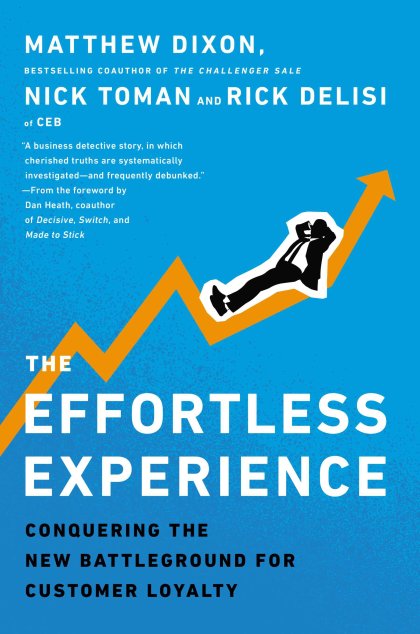
The Effortless Experience
The Effortless Experience
Couldn't load pickup availability
Collapsible content
ABOUT
In their acclaimed bestseller The Challenger Sale, Matthew Dixon and his colleagues at CEB busted many longstanding myths about sales. Now they’ve turned their research and analysis to a new vital business subject—customer loyalty—with a new book that turns the conventional wisdom on its head.
The idea that companies must delight customers by exceeding service expectations is so entrenched that managers rarely even question it. They devote untold time, energy, and resources to trying to dazzle people and inspire their undying loyalty. Yet CEB’s careful research over five years and tens of thousands of respondents proves that the “dazzle factor” is wildly overrated—it simply doesn’t predict repeat sales, share of wallet, or positive wordof-mouth. The reality:
Loyalty is driven by how well a company delivers on its basic promises and solves day-to-day problems, not on how spectacular its service experience might be. Most customers don’t want to be “wowed”; they want an effortless experience. And they are far more likely to punish you for bad service than to reward you for good service.
If you put on your customer hat rather than your manager or marketer hat, this makes a lot of sense. What do you really want from your cable company, a free month of HBO when it screws up or a fast, painless restoration of your connection? What about your bank—do you want free cookies and a cheerful smile, even a personal relationship with your teller? Or just a quick in-and-out transaction and an easy way to get a refund when it accidentally overcharges on fees?
The Effortless Experience takes readers on a fascinating journey deep inside the customer experience to reveal what really makes customers loyal—and disloyal. The authors lay out the four key pillars of a low-effort customer experience, along the way delivering robust data, shocking insights and profiles of companies that are already using the principles revealed by CEB’s research, with great results. And they include many tools and templates you can start applying right away to improve service, reduce costs, decrease customer churn, and ultimately generate the elusive loyalty that the “dazzle factor” fails to deliver.
The rewards are there for the taking, and the pathway to achieving them is now clearly marked.
STANDARD, PRIMARY, DM AND VARIANT COVERS
Standard and Primary covers are widely available through general retailers. They often have higher print runs and can be cheaper, especially during sales.
In contrast, Direct Market (DM) and variant covers are primarily sold in comic shops. DM editions tend to have more limited availability and may be more valuable to collectors.
The main differences lie in artwork style, availability, price, and collector appeal. Ultimately, the choice between standard and variant covers depends on personal preference, budget, and individual collecting goals.
PRODUCT TYPES
Comic book enthusiasts have various formats to choose from when collecting their favorite stories.
Here's a brief overview of the main types:
Omnibus
- Large, hardcover collections
- Usually contain complete runs or extensive story arcs
- Typically 800-1000+ pages
- Higher price point, often €100-€150
Oversized Hardcover (OHC)
- Similar dimensions to omnibus, but thinner
- Collect shorter runs or story arcs
- Usually 300-600 pages
- Priced between €30-€50
Hardcover (HC)
- Standard-sized hardcover books
- Collect 6-12 issues typically
- Similar dimensions to single issues, but with a hard cover
- Priced around €25-€35
Trade Paperback (TP)
- Softcover collections
- Standard comic book size
- Usually collect 4-6 issues
- Most affordable option, typically €15-€25
Other Formats
- Absolute Editions: Oversized, deluxe hardcovers (mainly DC Comics)
- Compendiums: Massive paperback collections
- Graphic Novels (OGN/GN): Original stories not previously released as single issues
The choice between these formats often depends on personal preference, budget, and collecting goals. Omnibus and OHC editions offer larger artwork and more content but at a higher price, while TPs provide a more affordable way to collect complete story arcs