

Random House Publishing Group
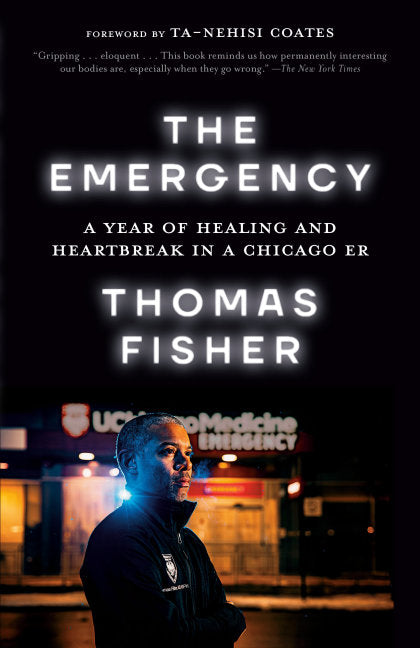
The Emergency
The Emergency
Couldn't load pickup availability
Collapsible content
ABOUT
“Gripping . . . eloquent . . . This book reminds us how permanently interesting our bodies are, especially when they go wrong.”—The New York Times
ONE OF THE BEST BOOKS OF THE YEAR: Time
As an emergency room doctor working on the rapid evaluation unit, Dr. Thomas Fisher has about three minutes to spend with the patients who come into the South Side of Chicago ward where he works before directing them to the next stage of their care. Bleeding: three minutes. Untreated wound that becomes life-threatening: three minutes. Kidney failure: three minutes. He examines his patients inside and out, touches their bodies, comforts and consoles them, and holds their hands on what is often the worst day of their lives. Like them, he grew up on the South Side; this is his community and he grinds day in and day out to heal them.
Through twenty years of clinical practice, time as a White House fellow, and work as a healthcare entrepreneur, Dr. Fisher has seen firsthand how our country’s healthcare system can reflect the worst of society: treating the poor as expendable in order to provide top-notch care to a few. In The Emergency, Fisher brings us through his shift, as he works with limited time and resources to treat incoming patients. And when he goes home, he remains haunted by what he sees throughout his day. The brutal wait times, the disconnect between hospital executives and policymakers and the people they're supposed to serve, and the inaccessible solutions that could help his patients. To cope with the relentless onslaught exacerbated by the pandemic, Fisher begins writing letters to patients and colleagues—letters he will never send—explaining it all to them as best he can.
As fast-paced as an ER shift, The Emergency has all the elements that make doctors’ stories so compelling—the high stakes, the fascinating science and practice of medicine, the deep and fraught interactions between patients and doctors, the persistent contemplation of mortality. And, with the rare dual perspective of somebody who also has his hands deep in policy work, Fisher connects these human stories to the sometimes-cruel machinery of care. Beautifully written, vulnerable and deeply empathetic, The Emergency is a call for reform that offers a fresh vision of health care as a foundation of social justice.
STANDARD, PRIMARY, DM AND VARIANT COVERS
Standard and Primary covers are widely available through general retailers. They often have higher print runs and can be cheaper, especially during sales.
In contrast, Direct Market (DM) and variant covers are primarily sold in comic shops. DM editions tend to have more limited availability and may be more valuable to collectors.
The main differences lie in artwork style, availability, price, and collector appeal. Ultimately, the choice between standard and variant covers depends on personal preference, budget, and individual collecting goals.
PRODUCT TYPES
Comic book enthusiasts have various formats to choose from when collecting their favorite stories.
Here's a brief overview of the main types:
Omnibus
- Large, hardcover collections
- Usually contain complete runs or extensive story arcs
- Typically 800-1000+ pages
- Higher price point, often €100-€150
Oversized Hardcover (OHC)
- Similar dimensions to omnibus, but thinner
- Collect shorter runs or story arcs
- Usually 300-600 pages
- Priced between €30-€50
Hardcover (HC)
- Standard-sized hardcover books
- Collect 6-12 issues typically
- Similar dimensions to single issues, but with a hard cover
- Priced around €25-€35
Trade Paperback (TP)
- Softcover collections
- Standard comic book size
- Usually collect 4-6 issues
- Most affordable option, typically €15-€25
Other Formats
- Absolute Editions: Oversized, deluxe hardcovers (mainly DC Comics)
- Compendiums: Massive paperback collections
- Graphic Novels (OGN/GN): Original stories not previously released as single issues
The choice between these formats often depends on personal preference, budget, and collecting goals. Omnibus and OHC editions offer larger artwork and more content but at a higher price, while TPs provide a more affordable way to collect complete story arcs