

Random House Publishing Group
The End of Advertising
The End of Advertising
Couldn't load pickup availability
Collapsible content
ABOUT
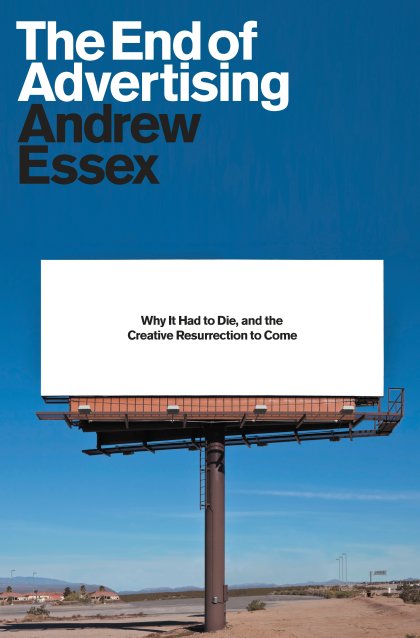
The ad apocalypse is upon us. Today millions are downloading ad-blocking software, and still more are paying subscription premiums to avoid ads. This $600 billion industry is now careening toward outright extinction, after having taken for granted a captive audience for too long, leading to lazy, overabundant, and frankly annoying ads. Make no mistake, Madison Avenue: Traditional advertising, as we know it, is over. In this short, controversial manifesto, Andrew Essex offers both a wake-up call and a road map to the future.
In The End of Advertising, Essex gives a brief and pungent history of the rise and fall of Adland—a story populated by snake-oil salesmen, slicksters, and search-engine optimizers. But his book is no eulogy. Instead, he boldly challenges global marketers to innovate their way to a better ad-free future. With trenchant wit and razor-sharp insights, he presents an essential new vision of where the smart businesses could be headed—a broad playing field where ambitious marketing campaigns provide utility, services, gifts, patronage of the arts, and even blockbuster entertainment. In this utopian landscape, ads could become so enticing that people would pay—yes, pay—to see them.
Praise for The End of Advertising
“New York media types aren’t quick to pass up a party, even one celebrating a book that predicts their demise. . . . The future of marketing will need to rely on creative, innovative models, Mr. Essex wrote, pointing to The Lego Movie and New York’s Citi Bike bicycle-share program as promising examples.”—The New York Times
“A rabble-rousing indictment of the ad industry from one of its own. Essex predicts that success will depend less on the ability to annoy and more on the capacity to create and entertain.”—Adam Grant, New York Times bestselling author of Originals and Give and Take
“Fresh and timely, The End of Advertising is an eye-opening take on the current media landscape. And along with it, Essex provides a road map for how brands can reinvent themselves and navigate this new world.”—Arianna Huffington
“In this dynamic little book, Essex challenges brands—even those of us who pride ourselves on thinking outside the box—to think bigger still. He’s got me thinking.”—Neil Blumenthal, co-founder of Warby Parker
“Mandatory reading for anyone who wants to get a message across in this age of authenticity.”—Alexis Ohanian, co-founder, Reddit
STANDARD, PRIMARY, DM AND VARIANT COVERS
Standard and Primary covers are widely available through general retailers. They often have higher print runs and can be cheaper, especially during sales.
In contrast, Direct Market (DM) and variant covers are primarily sold in comic shops. DM editions tend to have more limited availability and may be more valuable to collectors.
The main differences lie in artwork style, availability, price, and collector appeal. Ultimately, the choice between standard and variant covers depends on personal preference, budget, and individual collecting goals.
PRODUCT TYPES
Comic book enthusiasts have various formats to choose from when collecting their favorite stories.
Here's a brief overview of the main types:
Omnibus
- Large, hardcover collections
- Usually contain complete runs or extensive story arcs
- Typically 800-1000+ pages
- Higher price point, often €100-€150
Oversized Hardcover (OHC)
- Similar dimensions to omnibus, but thinner
- Collect shorter runs or story arcs
- Usually 300-600 pages
- Priced between €30-€50
Hardcover (HC)
- Standard-sized hardcover books
- Collect 6-12 issues typically
- Similar dimensions to single issues, but with a hard cover
- Priced around €25-€35
Trade Paperback (TP)
- Softcover collections
- Standard comic book size
- Usually collect 4-6 issues
- Most affordable option, typically €15-€25
Other Formats
- Absolute Editions: Oversized, deluxe hardcovers (mainly DC Comics)
- Compendiums: Massive paperback collections
- Graphic Novels (OGN/GN): Original stories not previously released as single issues
The choice between these formats often depends on personal preference, budget, and collecting goals. Omnibus and OHC editions offer larger artwork and more content but at a higher price, while TPs provide a more affordable way to collect complete story arcs