

Random House Publishing Group
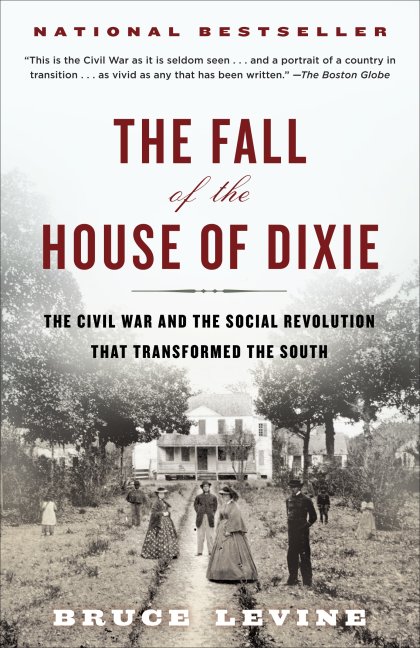
The Fall of the House of Dixie
The Fall of the House of Dixie
Couldn't load pickup availability
Collapsible content
ABOUT
In 1860 the American South was a vast, wealthy, imposing region where a small minority had amassed great political power and enormous fortunes through a system of forced labor. The South’s large population of slaveless whites almost universally supported the basic interests of plantation owners, despite the huge wealth gap that separated them. By the end of 1865 these structures of wealth and power had been shattered. Millions of black people had gained their freedom, many poorer whites had ceased following their wealthy neighbors, and plantation owners were brought to their knees, losing not only their slaves but their political power, their worldview, their very way of life. This sea change was felt nationwide, as the balance of power in Congress, the judiciary, and the presidency shifted dramatically and lastingly toward the North, and the country embarked on a course toward equal rights.
Levine captures the many-sided human drama of this story using a huge trove of diaries, letters, newspaper articles, government documents, and more. In The Fall of the House of Dixie, the true stakes of the Civil War become clearer than ever before, as slaves battle for their freedom in the face of brutal reprisals; Abraham Lincoln and his party turn what began as a limited war for the Union into a crusade against slavery by issuing the Emancipation Proclamation; poor southern whites grow increasingly disillusioned with fighting what they have come to see as the plantation owners’ war; and the slave owners grow ever more desperate as their beloved social order is destroyed, not just by the Union Army, but also from within. When the smoke clears, not only Dixie but all of American society is changed forever.
Brilliantly argued and engrossing, The Fall of the House of Dixie is a sweeping account of the destruction of the old South during the Civil War, offering a fresh perspective on the most colossal struggle in our history and the new world it brought into being.
Praise for The Fall of the House of Dixie
“This is the Civil War as it is seldom seen. . . . A portrait of a country in transition . . . as vivid as any that has been written.”—The Boston Globe
“An absorbing social history . . . For readers whose Civil War bibliography runs to standard works by Bruce Catton and James McPherson, [Bruce] Levine’s book offers fresh insights.”—The Wall Street Journal
“More poignantly than any book before, The Fall of the House of Dixie shows how deeply intertwined the Confederacy was with slavery, and how the destruction of both made possible a ‘second American revolution’ as far-reaching as the first.”—David W. Blight, author of American Oracle
“Splendidly colorful . . . Levine recounts this tale of Southern institutional rot with the ease and authority born of decades of study.”—Kirkus Reviews (starred review)
“A deep, rich, and complex analysis of the period surrounding and including the American Civil War.”—Publishers Weekly (starred review)
STANDARD, PRIMARY, DM AND VARIANT COVERS
Standard and Primary covers are widely available through general retailers. They often have higher print runs and can be cheaper, especially during sales.
In contrast, Direct Market (DM) and variant covers are primarily sold in comic shops. DM editions tend to have more limited availability and may be more valuable to collectors.
The main differences lie in artwork style, availability, price, and collector appeal. Ultimately, the choice between standard and variant covers depends on personal preference, budget, and individual collecting goals.
PRODUCT TYPES
Comic book enthusiasts have various formats to choose from when collecting their favorite stories.
Here's a brief overview of the main types:
Omnibus
- Large, hardcover collections
- Usually contain complete runs or extensive story arcs
- Typically 800-1000+ pages
- Higher price point, often €100-€150
Oversized Hardcover (OHC)
- Similar dimensions to omnibus, but thinner
- Collect shorter runs or story arcs
- Usually 300-600 pages
- Priced between €30-€50
Hardcover (HC)
- Standard-sized hardcover books
- Collect 6-12 issues typically
- Similar dimensions to single issues, but with a hard cover
- Priced around €25-€35
Trade Paperback (TP)
- Softcover collections
- Standard comic book size
- Usually collect 4-6 issues
- Most affordable option, typically €15-€25
Other Formats
- Absolute Editions: Oversized, deluxe hardcovers (mainly DC Comics)
- Compendiums: Massive paperback collections
- Graphic Novels (OGN/GN): Original stories not previously released as single issues
The choice between these formats often depends on personal preference, budget, and collecting goals. Omnibus and OHC editions offer larger artwork and more content but at a higher price, while TPs provide a more affordable way to collect complete story arcs