

Random House Publishing Group
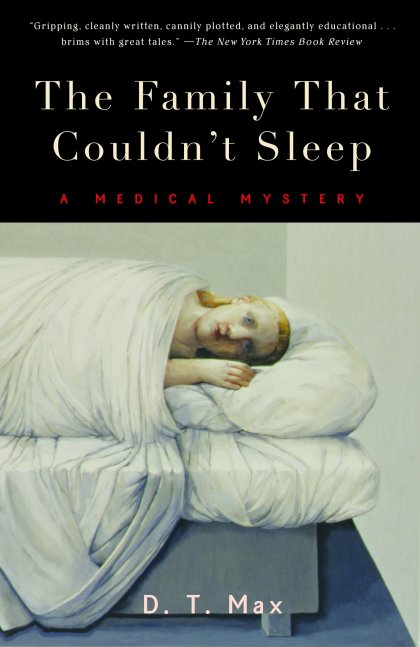
The Family That Couldn't Sleep
The Family That Couldn't Sleep
Couldn't load pickup availability
Collapsible content
ABOUT
What these strange conditions–including fatal familial insomnia, kuru, scrapie, and mad cow disease–share is their cause: prions. Prions are ordinary proteins that sometimes go wrong, resulting in neurological illnesses that are always fatal. Even more mysterious and frightening, prions are almost impossible to destroy because they are not alive and have no DNA–and the diseases they bring are now spreading around the world.
In The Family That Couldn’t Sleep, essayist and journalist D. T. Max tells the spellbinding story of the prion’s hidden past and deadly future. Through exclusive interviews and original archival research, Max explains this story’s connection to human greed and ambition–from the Prussian chemist Justus von Liebig, who made cattle meatier by feeding them the flesh of other cows, to New Guinean natives whose custom of eating the brains of the dead nearly wiped them out. The biologists who have investigated these afflictions are just as extraordinary–for example, Daniel Carleton Gajdusek, a self-described
“pedagogic pedophiliac pediatrician” who cracked kuru and won the Nobel Prize, and another Nobel winner, Stanley Prusiner, a driven, feared self-promoter who identified the key protein that revolutionized prion study.
With remarkable precision, grace, and sympathy, Max–who himself suffers from an inherited neurological illness–explores maladies that have tormented humanity for centuries and gives reason to hope that someday cures will be found. And he eloquently demonstrates that in our relationship to nature and these ailments, we have been our own worst enemy.
Advance praise
“The Family that Couldn’t Sleep is a riveting detective story that plumbs one of the deepest mysteries of biology. The story takes the reader from the torments of an Italian family cursed with sleeplessness to the mad cows of England (and, now, America), following an unlikely trail of misfolded proteins. D. T. Max unfolds his absorbing narrative with rare grace and makes the science sing.” –Michael Pollan, author of The Omnivore’s Dilemma and The Botany of Desire
“Much has been written about prions and Mad Cow Disease–nearly all of it is worthless. Thankfully, from the world of journalism comes D.T. Max to set things right. Throw all those other “Mad Cow” books in the trash: This is the book to read about prions–or whatever you want to call them. It’s a riveting tale, told by someone with a very special understanding, derived in part from his own strange ailment. Find a cozy spot, clear your schedule and dive in.”
– Laurie Garrett, author of Betrayal of Trust and The Coming Plague
“D. T. Max deftly unfolds the mysterious prion in all its villainous guises. Although scientists do not fully understand these proteins–how they replicate and wreak such havoc in their victims’ brains–The Family That Couldn’t Sleep reveals their historical, cultural, and scientific place in our world. Prepare to be enlightened, entertained, and frightened.”
–Katrina Firlik, MD, author of Another Day in the Frontal Lobe
“A great book. D.T. Max has drawn the curtain on a cabinet of folly and malady that will stagger your imagination.”
– Philip Weiss, author of American Taboo
“D.T. Max has combined the enthralling medical anthropology of Oliver Sacks with the gothic horror of Stephen King to produce a medical detective story that is as intelligent as it is spooky. The villain of The Family That Couldn’t Sleep is the prion, a tiny little protein that causes some of the most terrifying, brain-mangling, creepy diseases known to man. Always fascinating–how could it not be, given that its characters include cannibals, mad cows, madder sheep, a Nobel prize-winning pedophile, and, most poignantly, an Italian family cursed by fatal insomnia?–Max’s book is also a gripping account of scientific discovery, and a heartfelt meditation on what it means to be cursed with an incurable, and brutal, illness.” – David Plotz, author of The Genius Factory
STANDARD, PRIMARY, DM AND VARIANT COVERS
Standard and Primary covers are widely available through general retailers. They often have higher print runs and can be cheaper, especially during sales.
In contrast, Direct Market (DM) and variant covers are primarily sold in comic shops. DM editions tend to have more limited availability and may be more valuable to collectors.
The main differences lie in artwork style, availability, price, and collector appeal. Ultimately, the choice between standard and variant covers depends on personal preference, budget, and individual collecting goals.
PRODUCT TYPES
Comic book enthusiasts have various formats to choose from when collecting their favorite stories.
Here's a brief overview of the main types:
Omnibus
- Large, hardcover collections
- Usually contain complete runs or extensive story arcs
- Typically 800-1000+ pages
- Higher price point, often €100-€150
Oversized Hardcover (OHC)
- Similar dimensions to omnibus, but thinner
- Collect shorter runs or story arcs
- Usually 300-600 pages
- Priced between €30-€50
Hardcover (HC)
- Standard-sized hardcover books
- Collect 6-12 issues typically
- Similar dimensions to single issues, but with a hard cover
- Priced around €25-€35
Trade Paperback (TP)
- Softcover collections
- Standard comic book size
- Usually collect 4-6 issues
- Most affordable option, typically €15-€25
Other Formats
- Absolute Editions: Oversized, deluxe hardcovers (mainly DC Comics)
- Compendiums: Massive paperback collections
- Graphic Novels (OGN/GN): Original stories not previously released as single issues
The choice between these formats often depends on personal preference, budget, and collecting goals. Omnibus and OHC editions offer larger artwork and more content but at a higher price, while TPs provide a more affordable way to collect complete story arcs