

Random House Publishing Group
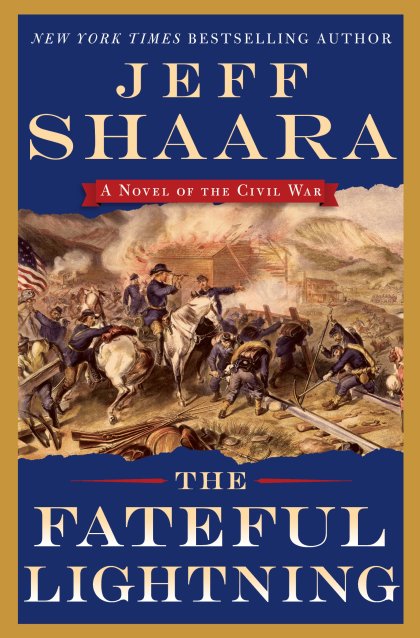
The Fateful Lightning
The Fateful Lightning
Couldn't load pickup availability
Collapsible content
ABOUT
November 1864: As the Civil War rolls into its fourth bloody year, the tide has turned decidedly in favor of the Union. A grateful Abraham Lincoln responds to Ulysses S. Grant’s successes by bringing the general east, promoting Grant to command the entire Union war effort, while William Tecumseh Sherman now directs the Federal forces that occupy all of Tennessee.
In a massive surge southward, Sherman conquers the city of Atlanta, sweeping aside the Confederate army under the inept leadership of General John Bell Hood. Pushing through northern Georgia, Sherman’s legendary March to the Sea shoves away any Rebel presence, and by Christmas 1864 the city of Savannah falls into the hands of “Uncle Billy.” Now there is but one direction for Sherman to go. In his way stands the last great hope for the Southern cause, General Joseph E. Johnston.
In the concluding novel of his epic Civil War tetralogy, Jeff Shaara tells the dramatic story of the final eight months of battle from multiple perspectives: the commanders in their tents making plans for total victory, as well as the ordinary foot soldiers and cavalrymen who carried out their orders until the last alarum sounded. Through Sherman’s eyes, we gain insight into the mind of the general who vowed to “make Georgia howl” until it surrendered. In Johnston, we see a man agonizing over the limits of his army’s power, and accepting the burden of leading the last desperate effort to ensure the survival of the Confederacy.
The Civil War did not end quietly. It climaxed in a storm of fury that lay waste to everything in its path. The Fateful Lightning brings to life those final brutal, bloody months of fighting with you-are-there immediacy, grounded in the meticulous research that readers have come to expect from Jeff Shaara.
Praise for The Fateful Lightning
“Powerful and emotional . . . highly recommended.”—Historical Novels Review
“Outstanding . . . Shaara combines his extensive knowledge of military history with his consummate skill as a storyteller.”—Booklist
“Readers . . . looking for an absorbing novel will be well rewarded.”—The Clarion-Ledger
“A great accomplishment and a more than fitting conclusion to Shaara’s work on the Civil War.”—Bookreporter
STANDARD, PRIMARY, DM AND VARIANT COVERS
Standard and Primary covers are widely available through general retailers. They often have higher print runs and can be cheaper, especially during sales.
In contrast, Direct Market (DM) and variant covers are primarily sold in comic shops. DM editions tend to have more limited availability and may be more valuable to collectors.
The main differences lie in artwork style, availability, price, and collector appeal. Ultimately, the choice between standard and variant covers depends on personal preference, budget, and individual collecting goals.
PRODUCT TYPES
Comic book enthusiasts have various formats to choose from when collecting their favorite stories.
Here's a brief overview of the main types:
Omnibus
- Large, hardcover collections
- Usually contain complete runs or extensive story arcs
- Typically 800-1000+ pages
- Higher price point, often €100-€150
Oversized Hardcover (OHC)
- Similar dimensions to omnibus, but thinner
- Collect shorter runs or story arcs
- Usually 300-600 pages
- Priced between €30-€50
Hardcover (HC)
- Standard-sized hardcover books
- Collect 6-12 issues typically
- Similar dimensions to single issues, but with a hard cover
- Priced around €25-€35
Trade Paperback (TP)
- Softcover collections
- Standard comic book size
- Usually collect 4-6 issues
- Most affordable option, typically €15-€25
Other Formats
- Absolute Editions: Oversized, deluxe hardcovers (mainly DC Comics)
- Compendiums: Massive paperback collections
- Graphic Novels (OGN/GN): Original stories not previously released as single issues
The choice between these formats often depends on personal preference, budget, and collecting goals. Omnibus and OHC editions offer larger artwork and more content but at a higher price, while TPs provide a more affordable way to collect complete story arcs