

Random House Publishing Group
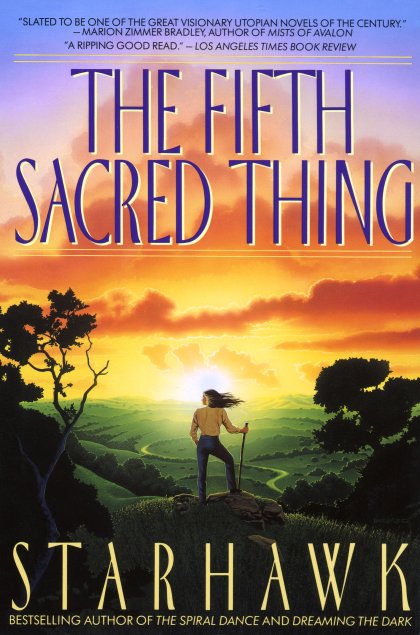
The Fifth Sacred Thing
The Fifth Sacred Thing
Couldn't load pickup availability
Collapsible content
ABOUT
Declaration of the Four Sacred Things
The earth is a living, conscious being. In company with cultures of many different times and places, we name these things as sacred: air, fire, water, and earth.
Whether we see them as the breath, energy, blood, and body of the Mother, or as the blessed gifts of a Creator, or as symbols of the interconnected systems that sustain life, we know that nothing can live without them.
To call these things sacred is to say that they have a value beyond their usefulness for human ends, that they themselves became the standards by which our acts, our economics, our laws, and our purposes must be judged. no one has the right to appropriate them or profit from them at the expense of others. Any government that fails to protect them forfeits its legitimacy.
All people, all living things, are part of the earth life, and so are sacred. No one of us stands higher or lower than any other. Only justice can assure balance: only ecological balance can sustain freedom. Only in freedom can that fifth sacred thing we call spirit flourish in its full diversity.
To honor the sacred is to create conditions in which nourishment, sustenance, habitat, knowledge, freedom, and beauty can thrive. To honor the sacred is to make love possible.
To this we dedicate our curiosity, our will, our courage, our silences, and our voices. To this we dedicate our lives.
Praise for The Fifth Sacred Thing
“This is wisdom wrapped in drama.”—Tom Hayden, California state senator
“Starhawk makes the jump to fiction quite smoothly with this memorable first novel.”—Locus
“Totally captivating . . . a vision of the paradigm shift that is essential for our very survival as a species on this planet.”—Elinor Gadon, author of The Once and Future Goddess
“This strong debut fits well against feminist futuristic, utopic, and dystopic works by the likes of Charlotte Perkins Gilman, Ursula LeGuin, and Margaret Atwood.”—Library Journal
STANDARD, PRIMARY, DM AND VARIANT COVERS
Standard and Primary covers are widely available through general retailers. They often have higher print runs and can be cheaper, especially during sales.
In contrast, Direct Market (DM) and variant covers are primarily sold in comic shops. DM editions tend to have more limited availability and may be more valuable to collectors.
The main differences lie in artwork style, availability, price, and collector appeal. Ultimately, the choice between standard and variant covers depends on personal preference, budget, and individual collecting goals.
PRODUCT TYPES
Comic book enthusiasts have various formats to choose from when collecting their favorite stories.
Here's a brief overview of the main types:
Omnibus
- Large, hardcover collections
- Usually contain complete runs or extensive story arcs
- Typically 800-1000+ pages
- Higher price point, often €100-€150
Oversized Hardcover (OHC)
- Similar dimensions to omnibus, but thinner
- Collect shorter runs or story arcs
- Usually 300-600 pages
- Priced between €30-€50
Hardcover (HC)
- Standard-sized hardcover books
- Collect 6-12 issues typically
- Similar dimensions to single issues, but with a hard cover
- Priced around €25-€35
Trade Paperback (TP)
- Softcover collections
- Standard comic book size
- Usually collect 4-6 issues
- Most affordable option, typically €15-€25
Other Formats
- Absolute Editions: Oversized, deluxe hardcovers (mainly DC Comics)
- Compendiums: Massive paperback collections
- Graphic Novels (OGN/GN): Original stories not previously released as single issues
The choice between these formats often depends on personal preference, budget, and collecting goals. Omnibus and OHC editions offer larger artwork and more content but at a higher price, while TPs provide a more affordable way to collect complete story arcs