

Random House Publishing Group
The First Clash
The First Clash
Couldn't load pickup availability
Collapsible content
ABOUT
“A compelling and provocative read . . . With a soldier’s eye, Jim Lacey re-creates the battle of Marathon in all its brutal simplicity.”—Barry Strauss, author of Masters of Command
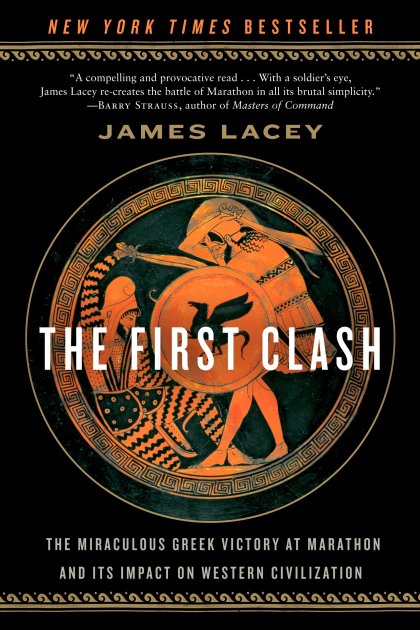
Marathon—one of history’s most pivotal battles. Its name evokes images of almost superhuman courage, endurance, and fighting spirit. In this eye-opening book, military analyst James Lacey takes a fresh look at Marathon and reveals why the battle happened, how it was fought, and whether, in fact, it saved Western civilization. Lacey brilliantly reconstructs the world of the fifth century B.C. leading up to the astonishing military defeat of the Persian Empire by the vastly undermanned Greek defenders. With the kind of vivid detail that characterizes the best modern war reportage, he shows how the heavily armed Persian army was shocked and demoralized by the relentless assault of the Athenian phalanx. He reveals the fascinating aftermath of Marathon, how its fighters became the equivalent of our “Greatest Generation,” and challenges the legacy and lessons that have often been misunderstood—perhaps, now more than ever, at our own peril.
Immediate, visceral, and full of new analyses that defy decades of conventional wisdom, The First Clash is a superb interpretation of a conflict that indeed made the world safe for Aristotle, Plato, and our own modern democracy.
“With a fresh eye to tactics, strategy, and military organization, and with his text grounded in direct experience of the troops on the battlefield, James Lacey gives us not only new understanding of how the Athenians managed to win but also a greater appreciation of the beginning of a long tradition of Western military dynamism that we take for granted today.”—Victor Davis Hanson, author of Carnage and Culture
“Lacey’s swords-and-shields approach will absorb readers ever fascinated by the famous battles of antiquity.”—Booklist
“A lively and rewarding read.”—Charleston Post and Courier
“Exemplary . . . Lacey, a veteran of the 82nd and 101st Airborne divisions and a professor at the Marine War College, brings to the tale of Marathon the practical experiences of the combat soldier and an intellectual sensibility.”—The New Criterion
STANDARD, PRIMARY, DM AND VARIANT COVERS
Standard and Primary covers are widely available through general retailers. They often have higher print runs and can be cheaper, especially during sales.
In contrast, Direct Market (DM) and variant covers are primarily sold in comic shops. DM editions tend to have more limited availability and may be more valuable to collectors.
The main differences lie in artwork style, availability, price, and collector appeal. Ultimately, the choice between standard and variant covers depends on personal preference, budget, and individual collecting goals.
PRODUCT TYPES
Comic book enthusiasts have various formats to choose from when collecting their favorite stories.
Here's a brief overview of the main types:
Omnibus
- Large, hardcover collections
- Usually contain complete runs or extensive story arcs
- Typically 800-1000+ pages
- Higher price point, often €100-€150
Oversized Hardcover (OHC)
- Similar dimensions to omnibus, but thinner
- Collect shorter runs or story arcs
- Usually 300-600 pages
- Priced between €30-€50
Hardcover (HC)
- Standard-sized hardcover books
- Collect 6-12 issues typically
- Similar dimensions to single issues, but with a hard cover
- Priced around €25-€35
Trade Paperback (TP)
- Softcover collections
- Standard comic book size
- Usually collect 4-6 issues
- Most affordable option, typically €15-€25
Other Formats
- Absolute Editions: Oversized, deluxe hardcovers (mainly DC Comics)
- Compendiums: Massive paperback collections
- Graphic Novels (OGN/GN): Original stories not previously released as single issues
The choice between these formats often depends on personal preference, budget, and collecting goals. Omnibus and OHC editions offer larger artwork and more content but at a higher price, while TPs provide a more affordable way to collect complete story arcs