

Candlewick Press
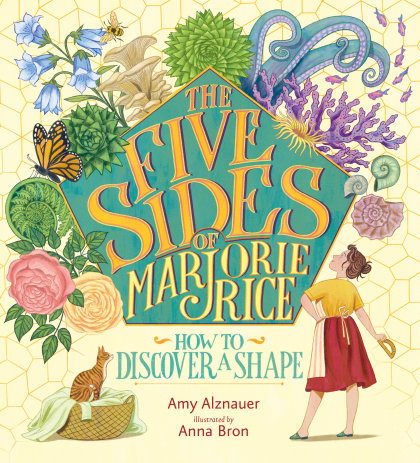
The Five Sides of Marjorie Rice: How to Discover a Shape
The Five Sides of Marjorie Rice: How to Discover a Shape
Couldn't load pickup availability
Collapsible content
ABOUT
Ablaze with pattern and color, this ebullient picture book biography celebrates the intersection of art and science—through the life and lens of an extraordinary amateur mathematician.
When Marjorie Rice was a little girl in Roseburg, Oregon, in the 1930s, she saw patterns everywhere. Swimming in the river, her body was a shape in the water, the water a shape in the hills, the hills a shape in the sky. Some shapes, fitted into a rectangle or floor tilings, were so beautiful they made her long to be an artist. Marjorie dreamed of studying art and geometry, perhaps even solving the age-old “problem of five” (why pentagons don’t fit together the way shapes with three, four, or six sides do). But when college wasn’t possible, she pondered and explored all through secretarial school, marriage, and parenting five children, until one day, while reading her son’s copy of Scientific American, she learned that a subscriber had discovered a pentagon never seen before. If a reader could do it, couldn’t she? Marjorie studied all the known pentagons, drew a little five-sided house, and kept pondering. She’d done it! And she’d go on to discover more pentagonal tilings and whole new classes of tessellations. In this visually wondrous tribute, Anna Bron’s intricate art teems with patterns, including nods to M. C. Escher, and radiates the thrill of one woman’s discovery, playfully inviting readers to approach geometry through art—and art through geometry. Back matter offers more on the story of five and suggestions on how to discover a shape.
STANDARD, PRIMARY, DM AND VARIANT COVERS
Standard and Primary covers are widely available through general retailers. They often have higher print runs and can be cheaper, especially during sales.
In contrast, Direct Market (DM) and variant covers are primarily sold in comic shops. DM editions tend to have more limited availability and may be more valuable to collectors.
The main differences lie in artwork style, availability, price, and collector appeal. Ultimately, the choice between standard and variant covers depends on personal preference, budget, and individual collecting goals.
PRODUCT TYPES
Comic book enthusiasts have various formats to choose from when collecting their favorite stories.
Here's a brief overview of the main types:
Omnibus
- Large, hardcover collections
- Usually contain complete runs or extensive story arcs
- Typically 800-1000+ pages
- Higher price point, often €100-€150
Oversized Hardcover (OHC)
- Similar dimensions to omnibus, but thinner
- Collect shorter runs or story arcs
- Usually 300-600 pages
- Priced between €30-€50
Hardcover (HC)
- Standard-sized hardcover books
- Collect 6-12 issues typically
- Similar dimensions to single issues, but with a hard cover
- Priced around €25-€35
Trade Paperback (TP)
- Softcover collections
- Standard comic book size
- Usually collect 4-6 issues
- Most affordable option, typically €15-€25
Other Formats
- Absolute Editions: Oversized, deluxe hardcovers (mainly DC Comics)
- Compendiums: Massive paperback collections
- Graphic Novels (OGN/GN): Original stories not previously released as single issues
The choice between these formats often depends on personal preference, budget, and collecting goals. Omnibus and OHC editions offer larger artwork and more content but at a higher price, while TPs provide a more affordable way to collect complete story arcs