

Random House Publishing Group
The French Ingredient
The French Ingredient
Couldn't load pickup availability
Collapsible content
ABOUT
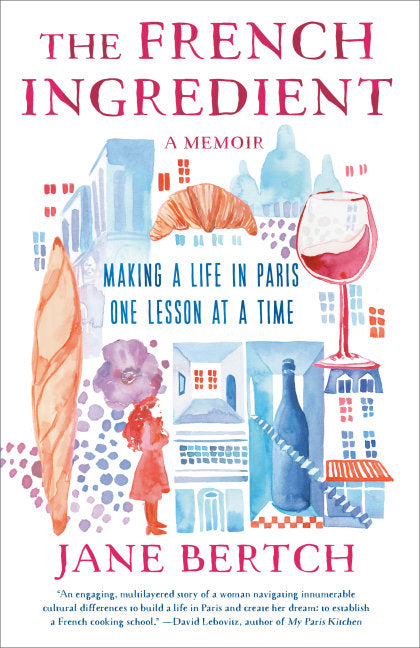
“An engaging, multilayered story of a woman navigating innumerable cultural differences to build a life in Paris and create her dream: to establish a French cooking school.”—David Lebovitz, author of My Paris Kitchen
When Jane Bertch was seventeen, her mother took her on a graduation trip to Paris. Thrilled to use her high school French, Jane found her halting attempts greeted with withering condescension by every waiter and shopkeeper she encountered. At the end of the trip, she vowed she would never return.
Yet a decade later she found herself back in Paris, transferred there by the American bank she worked for. She became fluent in the language and excelled in her new position. But she had a different dream: to start a cooking school for foreigners like her, who wanted to take a few classes in French cuisine in a friendly setting, then bring their new skills to their kitchens back home. Predictably, Jane faced the skeptical French—how dare an American banker start a cooking school in Paris?—as well as real-estate nightmares, and a long struggle to find and attract clients.
Thanks to Jane’s perseverance, La Cuisine Paris opened in 2009. Now the school is thriving, welcoming international visitors to come in and knead dough, whisk bechamel, whip meringue, and learn the care, precision, patience, and beauty involved in French cooking.
The French Ingredient is the story of a young female entrepreneur building a life in a city and culture she grew to love. As she established her school, Jane learned how to charm, how to project confidence, and how to give it right back to rude waiters. Having finally made peace with the city she swore to never revisit, she now offers a love letter to France, and a master class in Parisian cooking—and living.
STANDARD, PRIMARY, DM AND VARIANT COVERS
Standard and Primary covers are widely available through general retailers. They often have higher print runs and can be cheaper, especially during sales.
In contrast, Direct Market (DM) and variant covers are primarily sold in comic shops. DM editions tend to have more limited availability and may be more valuable to collectors.
The main differences lie in artwork style, availability, price, and collector appeal. Ultimately, the choice between standard and variant covers depends on personal preference, budget, and individual collecting goals.
PRODUCT TYPES
Comic book enthusiasts have various formats to choose from when collecting their favorite stories.
Here's a brief overview of the main types:
Omnibus
- Large, hardcover collections
- Usually contain complete runs or extensive story arcs
- Typically 800-1000+ pages
- Higher price point, often €100-€150
Oversized Hardcover (OHC)
- Similar dimensions to omnibus, but thinner
- Collect shorter runs or story arcs
- Usually 300-600 pages
- Priced between €30-€50
Hardcover (HC)
- Standard-sized hardcover books
- Collect 6-12 issues typically
- Similar dimensions to single issues, but with a hard cover
- Priced around €25-€35
Trade Paperback (TP)
- Softcover collections
- Standard comic book size
- Usually collect 4-6 issues
- Most affordable option, typically €15-€25
Other Formats
- Absolute Editions: Oversized, deluxe hardcovers (mainly DC Comics)
- Compendiums: Massive paperback collections
- Graphic Novels (OGN/GN): Original stories not previously released as single issues
The choice between these formats often depends on personal preference, budget, and collecting goals. Omnibus and OHC editions offer larger artwork and more content but at a higher price, while TPs provide a more affordable way to collect complete story arcs