

Penguin Publishing Group
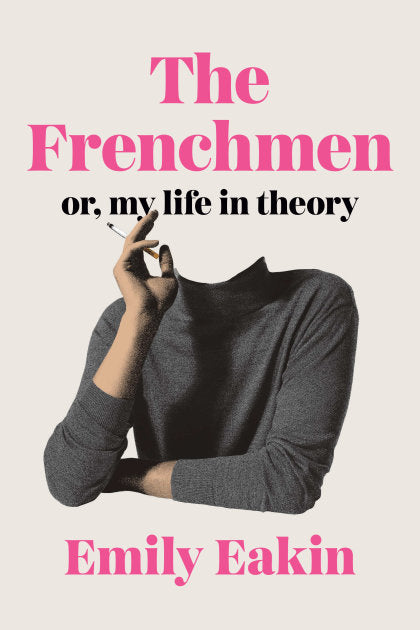
The Frenchmen
The Frenchmen
Couldn't load pickup availability
Collapsible content
ABOUT
“A superbly engrossing adventure of ideas...this will surely be my philosophy book of the year.” —Sarah Bakewell, New York Times bestselling author of Humanly Possible
From leading critic and essayist Emily Eakin, a stylish personal history of French theory and its unlikely domination of American culture
When Emily Eakin arrived at Harvard in the late 1980s, she fell under the spell of an eclectic body of philosophical texts by a handful of French authors. This was French theory, a set of recondite ideas that had taken American campuses by a storm during the preceding decades. In retrospect, the influence of these men and their writings seems both extraordinary and improbable. The Frenchmen argued that language is all-powerful, meaning unstable, and the self is an illusion. Their prose was brilliant, dazzling even, but often mystifyingly elaborate and highly abstract. Yet American students and scholars flocked to their books and lectures, intoxicated by a powerful new means of understanding—and perhaps even changing—the world. For Eakin, an unsophisticated graduate of a small-town Midwestern high school, theory was no mere intellectual exercise but a way of being—a heady shortcut to worldly glamour and wisdom.
The Frenchmen is the story of Eakin’s youthful love affair with French theory, alongside a wider examination of its rise and fall. Looking closely at Jacques Derrida, Louis Althusser, Roland Barthes, Gilles Deleuze, Michel Foucault, Félix Guattari, Jacques Lacan, and the French-speaking Belgian Paul de Man, Eakin untangles their famously difficult works with peerless, delightful clarity. What’s more, she brings to light the eccentric, scandalous—at times criminal!—lives of thinkers who themselves were often highly averse to biography, in a daringly original weave of storytelling and exegesis.
As she explores the magnetism of their work, Eakin illuminates not just the Frenchmen’s enduring legacy but some of today’s deepest political, social, and intellectual arguments. She neither rejects nor flatters the Frenchmen’s ideas but instead reveals how they indelibly changed our understanding of power, truth, and identity. Eakin shows how, for better or worse, the Frenchmen continue to shape and unsettle our lives today.
STANDARD, PRIMARY, DM AND VARIANT COVERS
Standard and Primary covers are widely available through general retailers. They often have higher print runs and can be cheaper, especially during sales.
In contrast, Direct Market (DM) and variant covers are primarily sold in comic shops. DM editions tend to have more limited availability and may be more valuable to collectors.
The main differences lie in artwork style, availability, price, and collector appeal. Ultimately, the choice between standard and variant covers depends on personal preference, budget, and individual collecting goals.
PRODUCT TYPES
Comic book enthusiasts have various formats to choose from when collecting their favorite stories.
Here's a brief overview of the main types:
Omnibus
- Large, hardcover collections
- Usually contain complete runs or extensive story arcs
- Typically 800-1000+ pages
- Higher price point, often €100-€150
Oversized Hardcover (OHC)
- Similar dimensions to omnibus, but thinner
- Collect shorter runs or story arcs
- Usually 300-600 pages
- Priced between €30-€50
Hardcover (HC)
- Standard-sized hardcover books
- Collect 6-12 issues typically
- Similar dimensions to single issues, but with a hard cover
- Priced around €25-€35
Trade Paperback (TP)
- Softcover collections
- Standard comic book size
- Usually collect 4-6 issues
- Most affordable option, typically €15-€25
Other Formats
- Absolute Editions: Oversized, deluxe hardcovers (mainly DC Comics)
- Compendiums: Massive paperback collections
- Graphic Novels (OGN/GN): Original stories not previously released as single issues
The choice between these formats often depends on personal preference, budget, and collecting goals. Omnibus and OHC editions offer larger artwork and more content but at a higher price, while TPs provide a more affordable way to collect complete story arcs