

Random House Publishing Group
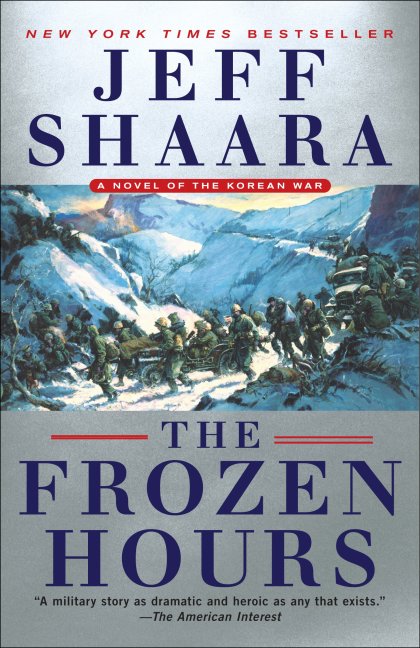
The Frozen Hours
The Frozen Hours
Couldn't load pickup availability
Collapsible content
ABOUT
June 1950. The North Korean army invades South Korea, intent on uniting the country under Communist rule. In response, the United States mobilizes a force to defend the overmatched South Korean troops, and together they drive the North Koreans back to their border with China.
But several hundred thousand Chinese troops have entered Korea, laying massive traps for the Allies. In November 1950, the Chinese spring those traps. Allied forces, already battling stunningly cold weather, find themselves caught completely off guard as the Chinese advance around the Chosin Reservoir in North Korea. A force that once stood on the precipice of victory now finds itself on the brink of annihilation. Assured by General Douglas MacArthur that they would be home by Christmas, the soldiers and Marines fight for their lives against the most brutal weather conditions imaginable—and an enemy that outnumbers them more than six to one.
The Frozen Hours tells the story of Frozen Chosin from multiple points of view: Oliver P. Smith, the commanding general of the American 1st Marine Division, who famously redefined retreat as “advancing in a different direction”; Marine Private Pete Riley, a World War II veteran who now faces the greatest fight of his life; and the Chinese commander Sung Shi-Lun, charged with destroying the Americans he has so completely surrounded, ever aware that above him, Chairman Mao Tse-Tung watches his every move.
Written with the propulsive force Jeff Shaara brings to all his novels of combat and courage, The Frozen Hours transports us to the critical moment in the history of America’s “Forgotten War,” when the fate of the Korean peninsula lay in the hands of a brave band of brothers battling both the elements and a determined, implacable foe.
“A military story as dramatic and heroic as any that exists.”—The American Interest
“The Frozen Hours . . . illustrates again Shaara’s mastery. . . . This is fiction and history at their blended best.”—Marine Corps Gazette
“Marvelously effective storytelling . . . that shows us what warfare feels like both to those who plan campaigns and those who execute them . . . gripping, precisely detailed historical fiction.”—Booklist (starred review)
STANDARD, PRIMARY, DM AND VARIANT COVERS
Standard and Primary covers are widely available through general retailers. They often have higher print runs and can be cheaper, especially during sales.
In contrast, Direct Market (DM) and variant covers are primarily sold in comic shops. DM editions tend to have more limited availability and may be more valuable to collectors.
The main differences lie in artwork style, availability, price, and collector appeal. Ultimately, the choice between standard and variant covers depends on personal preference, budget, and individual collecting goals.
PRODUCT TYPES
Comic book enthusiasts have various formats to choose from when collecting their favorite stories.
Here's a brief overview of the main types:
Omnibus
- Large, hardcover collections
- Usually contain complete runs or extensive story arcs
- Typically 800-1000+ pages
- Higher price point, often €100-€150
Oversized Hardcover (OHC)
- Similar dimensions to omnibus, but thinner
- Collect shorter runs or story arcs
- Usually 300-600 pages
- Priced between €30-€50
Hardcover (HC)
- Standard-sized hardcover books
- Collect 6-12 issues typically
- Similar dimensions to single issues, but with a hard cover
- Priced around €25-€35
Trade Paperback (TP)
- Softcover collections
- Standard comic book size
- Usually collect 4-6 issues
- Most affordable option, typically €15-€25
Other Formats
- Absolute Editions: Oversized, deluxe hardcovers (mainly DC Comics)
- Compendiums: Massive paperback collections
- Graphic Novels (OGN/GN): Original stories not previously released as single issues
The choice between these formats often depends on personal preference, budget, and collecting goals. Omnibus and OHC editions offer larger artwork and more content but at a higher price, while TPs provide a more affordable way to collect complete story arcs