

Library of America
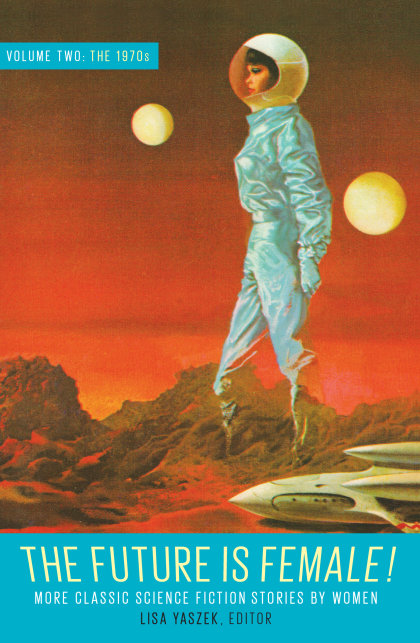
The Future Is Female! Volume Two, The 1970s: More Classic Science Fiction Stories By Women
The Future Is Female! Volume Two, The 1970s: More Classic Science Fiction Stories By Women
Couldn't load pickup availability
Collapsible content
ABOUT
In the 1970s, feminist authors created a new mode of science fiction in defiance of the “baboon patriarchy”—Ursula Le Guin’s words—that had long dominated the genre, imagining futures that are still visionary. In this sequel to her groundbreaking 2018 anthology The Future is Female!: 25 Classic Science Fiction Stories by Women from Pulp Pioneers to Ursula K. Le Guin, SF-expert Lisa Yaszek offers a time machine back to the decade when far-sighted rebels changed science fiction forever with stories that made female community, agency, and sexuality central to the American future.
Here are twenty-three wild, witty, and wonderful classics that dramatize the liberating energies of the 1970s:
- Sonya Dorman, “Bitching It” (1971)
- Kate Wilhelm, “The Funeral” (1972)
- Joanna Russ, “When It Changed” (1972) NEBULA AWARD
- Miriam Allen deFord, “A Way Out”(1973)
- Vonda N. McIntyre, “Of Mist, and Grass, and Sand” (1973) NEBULA
- James Tiptree, Jr., “The Girl Who Was Plugged In” (1973) HUGO AWARD
- Kathleen Sky, “Lament of the Keeku Bird” (1973)
- Ursula K. Le Guin, “The Day Before the Revolution” (1974) NEBULA & LOCUS AWARD
- Eleanor Arnason, “The Warlord of Saturn’s Moons” (1974)
- Kathleen M. Sidney, “The Anthropologist” (1975)
- Marta Randall, “A Scarab in the City of Time” (1975)
- Elinor Busby, “A Time to Kill” (1977)
- Raccoona Sheldon, “The Screwfly Solution” (1977) NEBULA AWARD
- Pamela Sargent, “If Ever I Should Leave You” (1974)
- Joan D. Vinge, “View from a Height” (1978)
- M. Lucie Chin, “The Best Is Yet to Be” (1978)
- Lisa Tuttle, “Wives” (1979)
- Connie Willis, “Daisy, In the Sun” (1979)
STANDARD, PRIMARY, DM AND VARIANT COVERS
Standard and Primary covers are widely available through general retailers. They often have higher print runs and can be cheaper, especially during sales.
In contrast, Direct Market (DM) and variant covers are primarily sold in comic shops. DM editions tend to have more limited availability and may be more valuable to collectors.
The main differences lie in artwork style, availability, price, and collector appeal. Ultimately, the choice between standard and variant covers depends on personal preference, budget, and individual collecting goals.
PRODUCT TYPES
Comic book enthusiasts have various formats to choose from when collecting their favorite stories.
Here's a brief overview of the main types:
Omnibus
- Large, hardcover collections
- Usually contain complete runs or extensive story arcs
- Typically 800-1000+ pages
- Higher price point, often €100-€150
Oversized Hardcover (OHC)
- Similar dimensions to omnibus, but thinner
- Collect shorter runs or story arcs
- Usually 300-600 pages
- Priced between €30-€50
Hardcover (HC)
- Standard-sized hardcover books
- Collect 6-12 issues typically
- Similar dimensions to single issues, but with a hard cover
- Priced around €25-€35
Trade Paperback (TP)
- Softcover collections
- Standard comic book size
- Usually collect 4-6 issues
- Most affordable option, typically €15-€25
Other Formats
- Absolute Editions: Oversized, deluxe hardcovers (mainly DC Comics)
- Compendiums: Massive paperback collections
- Graphic Novels (OGN/GN): Original stories not previously released as single issues
The choice between these formats often depends on personal preference, budget, and collecting goals. Omnibus and OHC editions offer larger artwork and more content but at a higher price, while TPs provide a more affordable way to collect complete story arcs