

Penguin Publishing Group
The Ghost Ships of Archangel
The Ghost Ships of Archangel
Couldn't load pickup availability
Collapsible content
ABOUT
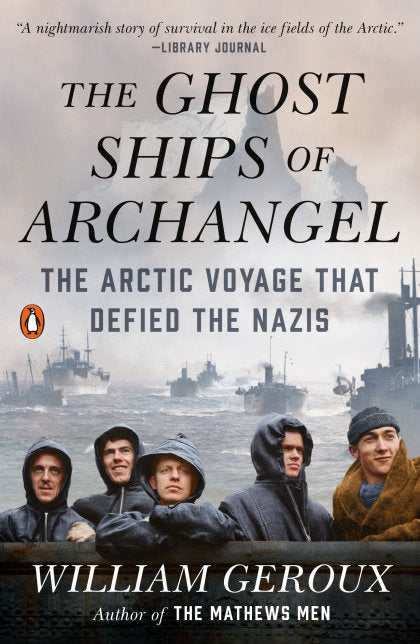
On the fourth of July, 1942, four Allied ships traversing the Arctic split from their decimated convoy to head further north into the ice field of the North Pole. They were seeking safety from Nazi bombers and U-boats in the perilous white maze of ice floes, growlers, and giant bergs. Despite the many risks of their chosen route, the four vessels had a better chance of reaching their destination than the rest of the remains of convoy PQ-17. The convoy had started as a fleet of thirty-five cargo ships carrying $1 billion worth of war supplies to the Soviet port of Archangel--the only help Roosevelt and Churchill had extended to Joseph Stalin to maintain their fragile alliance against Germany. At the most dangerous point of the voyage, the ships had received a startling order to scatter and had quickly become easy prey for the Nazis.
The crews of the four ships focused on their mission. U.S. Navy Ensign Howard Carraway, aboard the SS Troubadour, was a farm boy from South Carolina and one of the many Americans for whom the convoy was a first taste of war; from the Royal Navy Reserve, Lt. Leo Gradwell was given command of the HMT Ayrshire, a British fishing trawler that had been converted into an antisubmarine vessel. The twenty-four-hour Arctic daylight in midsummer gave them no respite from bombers or submarines, and they all feared the giant German battleship Tirpitz, nicknamed the "Big Bad Wolf." Icebergs were as dangerous as Nazis as the remnants of convoy PQ-17 tried to slip through the Arctic to deliver their cargo in one of the most dramatic escapes of World War II. At Archangel they found a traumatized, starving city, and a disturbing preview of the Cold War ahead.
STANDARD, PRIMARY, DM AND VARIANT COVERS
Standard and Primary covers are widely available through general retailers. They often have higher print runs and can be cheaper, especially during sales.
In contrast, Direct Market (DM) and variant covers are primarily sold in comic shops. DM editions tend to have more limited availability and may be more valuable to collectors.
The main differences lie in artwork style, availability, price, and collector appeal. Ultimately, the choice between standard and variant covers depends on personal preference, budget, and individual collecting goals.
PRODUCT TYPES
Comic book enthusiasts have various formats to choose from when collecting their favorite stories.
Here's a brief overview of the main types:
Omnibus
- Large, hardcover collections
- Usually contain complete runs or extensive story arcs
- Typically 800-1000+ pages
- Higher price point, often €100-€150
Oversized Hardcover (OHC)
- Similar dimensions to omnibus, but thinner
- Collect shorter runs or story arcs
- Usually 300-600 pages
- Priced between €30-€50
Hardcover (HC)
- Standard-sized hardcover books
- Collect 6-12 issues typically
- Similar dimensions to single issues, but with a hard cover
- Priced around €25-€35
Trade Paperback (TP)
- Softcover collections
- Standard comic book size
- Usually collect 4-6 issues
- Most affordable option, typically €15-€25
Other Formats
- Absolute Editions: Oversized, deluxe hardcovers (mainly DC Comics)
- Compendiums: Massive paperback collections
- Graphic Novels (OGN/GN): Original stories not previously released as single issues
The choice between these formats often depends on personal preference, budget, and collecting goals. Omnibus and OHC editions offer larger artwork and more content but at a higher price, while TPs provide a more affordable way to collect complete story arcs