

Random House Publishing Group
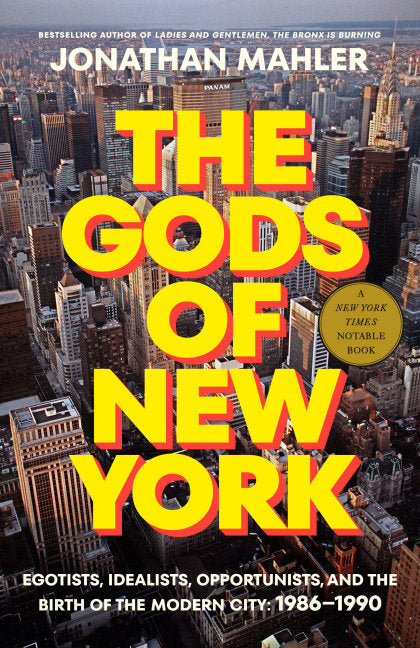
The Gods of New York
The Gods of New York
Couldn't load pickup availability
Collapsible content
ABOUT
“A rip-roaring, sweeping, essential work of history . . . a deeply reported and brilliantly observed account of how the modern city was born and why all of us continue to live with the results.”—Jonathan Eig, Pulitzer Prize–winning author of King: A Life
A BEST BOOK OF THE YEAR: The New York Times Book Review, The Economist, The New Yorker, Town & Country
New York entered 1986 as a city reborn. Record profits on Wall Street sent waves of money splashing across Manhattan, bringing a battered city roaring back to life.
But it also entered 1986 as a city whose foundation was beginning to crack. Thousands of New Yorkers were sleeping in the streets, addicted to drugs, dying of AIDS, or suffering from mental illnesses. Nearly one-third of the city’s Black and Hispanic residents were living below the federal poverty line. Long-simmering racial tensions threatened to boil over.
The events of the next four years would split the city open. Howard Beach. Black Monday. Tawana Brawley. The crack epidemic. The birth of ACT UP. The Central Park jogger. The release of Do the Right Thing. And a cast of outsized characters—Ed Koch, Donald Trump, Al Sharpton, Spike Lee, Rudy Giuliani, Larry Kramer—would compete to shape the city’s future while building their own mythologies.
The Gods of New York is a kaleidoscopic and deeply immersive portrait of a city whose identity was suddenly up for grabs: Could it be both the great working-class city that lifted up immigrants from around the world and the money-soaked capital of global finance? Could it retain a civic culture—a common idea of what it meant to be a New Yorker—when the rich were building a city of their own and vast swaths of its citizens were losing faith in the systems meant to protect them? New York City was one thing at the dawn of 1986; it would be something very different as 1989 came to a close. This is the story of how that happened.
STANDARD, PRIMARY, DM AND VARIANT COVERS
Standard and Primary covers are widely available through general retailers. They often have higher print runs and can be cheaper, especially during sales.
In contrast, Direct Market (DM) and variant covers are primarily sold in comic shops. DM editions tend to have more limited availability and may be more valuable to collectors.
The main differences lie in artwork style, availability, price, and collector appeal. Ultimately, the choice between standard and variant covers depends on personal preference, budget, and individual collecting goals.
PRODUCT TYPES
Comic book enthusiasts have various formats to choose from when collecting their favorite stories.
Here's a brief overview of the main types:
Omnibus
- Large, hardcover collections
- Usually contain complete runs or extensive story arcs
- Typically 800-1000+ pages
- Higher price point, often €100-€150
Oversized Hardcover (OHC)
- Similar dimensions to omnibus, but thinner
- Collect shorter runs or story arcs
- Usually 300-600 pages
- Priced between €30-€50
Hardcover (HC)
- Standard-sized hardcover books
- Collect 6-12 issues typically
- Similar dimensions to single issues, but with a hard cover
- Priced around €25-€35
Trade Paperback (TP)
- Softcover collections
- Standard comic book size
- Usually collect 4-6 issues
- Most affordable option, typically €15-€25
Other Formats
- Absolute Editions: Oversized, deluxe hardcovers (mainly DC Comics)
- Compendiums: Massive paperback collections
- Graphic Novels (OGN/GN): Original stories not previously released as single issues
The choice between these formats often depends on personal preference, budget, and collecting goals. Omnibus and OHC editions offer larger artwork and more content but at a higher price, while TPs provide a more affordable way to collect complete story arcs