

Penguin Young Readers Group
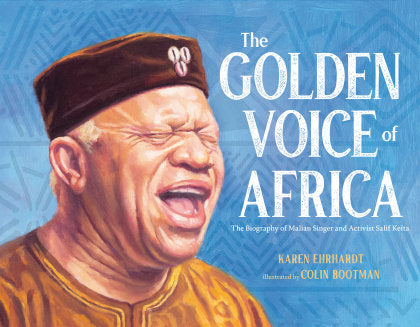
The Golden Voice of Africa
The Golden Voice of Africa
Couldn't load pickup availability
Collapsible content
ABOUT
Salif Keïta was born in the Malian village Djoliba in West Africa. While his parents were as dark as the night sky, Salif was born with skin as white as lamb’s wool. Some of his family's neighbors were frightened by Salif's albinism. Others questioned whether Salif was fit to live, making his mother hold him close.
But as Salif grew, trying to keep him safe from harm was like trying to hold the harmattan wind in his mother's hands. Even though the sun would make Salif's skin blister painfully, he always went back for more. The life outside his family's hut called to him.
Music called to Salif, too, and helped him forget the pain of being different. He was captivated by the griots who would come to serenade his family. But when Salif once spied an unattended balafon, tempted to strike its keys, Salif's father admonished him: "Remember who you are," he said. "We Keïtas do not play music."
The Keïta family were warriors, hunters and farmers. They were not musicians. But still Salif could not forget how music made him feel, how when he sang, his voice pierced through his pain allowing him to wail triumphantly at everyone and everything that made him feel powerless and ugly.
So, at age eighteen Salif decided to hitch a ride to the city to see if he could make a living through song.
Karen Ehrhardt's lyrical, affecting words paired with Colin Bootman's dynamic, lush art meld effortlessly to chronicle the untold story of a legend whose music and resilience has influenced and inspired generations.
STANDARD, PRIMARY, DM AND VARIANT COVERS
Standard and Primary covers are widely available through general retailers. They often have higher print runs and can be cheaper, especially during sales.
In contrast, Direct Market (DM) and variant covers are primarily sold in comic shops. DM editions tend to have more limited availability and may be more valuable to collectors.
The main differences lie in artwork style, availability, price, and collector appeal. Ultimately, the choice between standard and variant covers depends on personal preference, budget, and individual collecting goals.
PRODUCT TYPES
Comic book enthusiasts have various formats to choose from when collecting their favorite stories.
Here's a brief overview of the main types:
Omnibus
- Large, hardcover collections
- Usually contain complete runs or extensive story arcs
- Typically 800-1000+ pages
- Higher price point, often €100-€150
Oversized Hardcover (OHC)
- Similar dimensions to omnibus, but thinner
- Collect shorter runs or story arcs
- Usually 300-600 pages
- Priced between €30-€50
Hardcover (HC)
- Standard-sized hardcover books
- Collect 6-12 issues typically
- Similar dimensions to single issues, but with a hard cover
- Priced around €25-€35
Trade Paperback (TP)
- Softcover collections
- Standard comic book size
- Usually collect 4-6 issues
- Most affordable option, typically €15-€25
Other Formats
- Absolute Editions: Oversized, deluxe hardcovers (mainly DC Comics)
- Compendiums: Massive paperback collections
- Graphic Novels (OGN/GN): Original stories not previously released as single issues
The choice between these formats often depends on personal preference, budget, and collecting goals. Omnibus and OHC editions offer larger artwork and more content but at a higher price, while TPs provide a more affordable way to collect complete story arcs