

Penguin Publishing Group
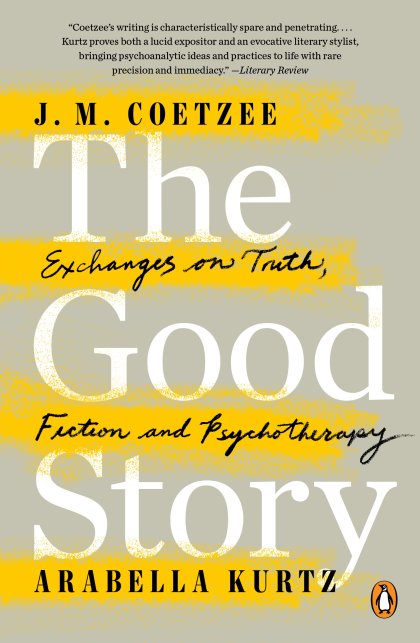
The Good Story
The Good Story
Couldn't load pickup availability
Collapsible content
ABOUT
J.M. Coetzee: What relationship do I have with my life history? Am I its conscious author, or should I think of myself as simply a voice uttering with as little interference as possible a stream of words welling up from my interior?
Arabella Kurtz: One way of thinking about psychoanalysis is to say that it is aimed at setting free the narrative or autobiographical imagination.
The Good Story is a fascinating dialogue about psychotherapy and the art of storytelling between a writer with a long-standing interest in moral psychology and a psychotherapist with training in literary studies. Coetzee and Kurtz consider psychotherapy and its wider social context from different perspectives, but at the heart of both of their approaches is a concern with narrative. Working alone, the writer is in control of the story he or she tells. The therapist, on the other hand, collaborates with the patient in developing an account of the patient's life and identity that is both meaningful and true.
In a meeting of minds that is illuminating and thought-provoking, the authors discuss both individual psychology and the psychology of the group: the school classroom, gangs and the settler nation, in which the brutal deeds of ancestors are accommodated into a national story. Drawing on great writers like Cervantes and Dostoevsky and psychoanalysts like Freud and Melanie Klein, Coetzee and Kurtz explore the human capacity for self-examination, our wish to tell our own life stories and the resistances we encounter along the way.
STANDARD, PRIMARY, DM AND VARIANT COVERS
Standard and Primary covers are widely available through general retailers. They often have higher print runs and can be cheaper, especially during sales.
In contrast, Direct Market (DM) and variant covers are primarily sold in comic shops. DM editions tend to have more limited availability and may be more valuable to collectors.
The main differences lie in artwork style, availability, price, and collector appeal. Ultimately, the choice between standard and variant covers depends on personal preference, budget, and individual collecting goals.
PRODUCT TYPES
Comic book enthusiasts have various formats to choose from when collecting their favorite stories.
Here's a brief overview of the main types:
Omnibus
- Large, hardcover collections
- Usually contain complete runs or extensive story arcs
- Typically 800-1000+ pages
- Higher price point, often €100-€150
Oversized Hardcover (OHC)
- Similar dimensions to omnibus, but thinner
- Collect shorter runs or story arcs
- Usually 300-600 pages
- Priced between €30-€50
Hardcover (HC)
- Standard-sized hardcover books
- Collect 6-12 issues typically
- Similar dimensions to single issues, but with a hard cover
- Priced around €25-€35
Trade Paperback (TP)
- Softcover collections
- Standard comic book size
- Usually collect 4-6 issues
- Most affordable option, typically €15-€25
Other Formats
- Absolute Editions: Oversized, deluxe hardcovers (mainly DC Comics)
- Compendiums: Massive paperback collections
- Graphic Novels (OGN/GN): Original stories not previously released as single issues
The choice between these formats often depends on personal preference, budget, and collecting goals. Omnibus and OHC editions offer larger artwork and more content but at a higher price, while TPs provide a more affordable way to collect complete story arcs