

Penguin Publishing Group
The Hacking of the American Mind
The Hacking of the American Mind
Couldn't load pickup availability
Collapsible content
ABOUT
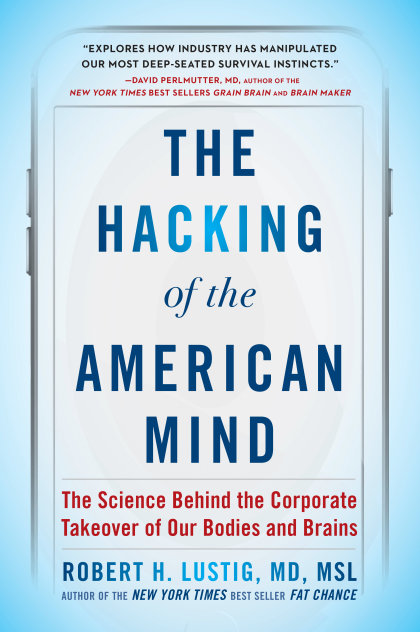
The New York Times–bestselling author of Fat Chance reveals the corporate scheme to sell pleasure, driving the international epidemic of addiction, depression, and chronic disease.
While researching the toxic and addictive properties of sugar for his New York Times bestseller Fat Chance, Robert Lustig made an alarming discovery—our pursuit of happiness is being subverted by a culture of addiction and depression from which we may never recover.
Dopamine is the “reward” neurotransmitter that tells our brains we want more; yet every substance or behavior that releases dopamine in the extreme leads to addiction. Serotonin is the “contentment” neurotransmitter that tells our brains we don’t need any more; yet its deficiency leads to depression. Ideally, both are in optimal supply. Yet dopamine evolved to overwhelm serotonin—because our ancestors were more likely to survive if they were constantly motivated—with the result that constant desire can chemically destroy our ability to feel happiness, while sending us down the slippery slope to addiction. In the last forty years, government legislation and subsidies have promoted ever-available temptation (sugar, drugs, social media, porn) combined with constant stress (work, home, money, Internet), with the end result of an unprecedented epidemic of addiction, anxiety, depression, and chronic disease. And with the advent of neuromarketing, corporate America has successfully imprisoned us in an endless loop of desire and consumption from which there is no obvious escape.
With his customary wit and incisiveness, Lustig not only reveals the science that drives these states of mind, he points his finger directly at the corporations that helped create this mess, and the government actors who facilitated it, and he offers solutions we can all use in the pursuit of happiness, even in the face of overwhelming opposition. Always fearless and provocative, Lustig marshals a call to action, with seminal implications for our health, our well-being, and our culture.
STANDARD, PRIMARY, DM AND VARIANT COVERS
Standard and Primary covers are widely available through general retailers. They often have higher print runs and can be cheaper, especially during sales.
In contrast, Direct Market (DM) and variant covers are primarily sold in comic shops. DM editions tend to have more limited availability and may be more valuable to collectors.
The main differences lie in artwork style, availability, price, and collector appeal. Ultimately, the choice between standard and variant covers depends on personal preference, budget, and individual collecting goals.
PRODUCT TYPES
Comic book enthusiasts have various formats to choose from when collecting their favorite stories.
Here's a brief overview of the main types:
Omnibus
- Large, hardcover collections
- Usually contain complete runs or extensive story arcs
- Typically 800-1000+ pages
- Higher price point, often €100-€150
Oversized Hardcover (OHC)
- Similar dimensions to omnibus, but thinner
- Collect shorter runs or story arcs
- Usually 300-600 pages
- Priced between €30-€50
Hardcover (HC)
- Standard-sized hardcover books
- Collect 6-12 issues typically
- Similar dimensions to single issues, but with a hard cover
- Priced around €25-€35
Trade Paperback (TP)
- Softcover collections
- Standard comic book size
- Usually collect 4-6 issues
- Most affordable option, typically €15-€25
Other Formats
- Absolute Editions: Oversized, deluxe hardcovers (mainly DC Comics)
- Compendiums: Massive paperback collections
- Graphic Novels (OGN/GN): Original stories not previously released as single issues
The choice between these formats often depends on personal preference, budget, and collecting goals. Omnibus and OHC editions offer larger artwork and more content but at a higher price, while TPs provide a more affordable way to collect complete story arcs