

Berrett-Koehler Publishers
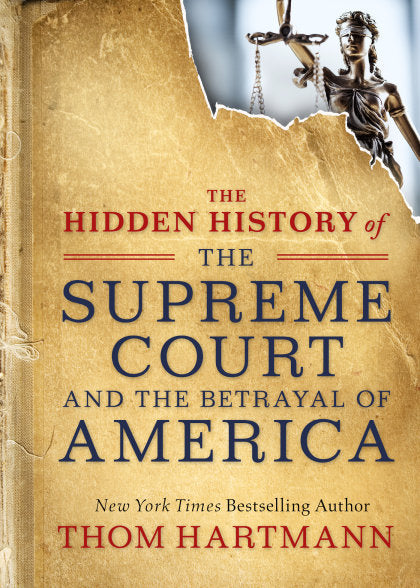
The Hidden History of the Supreme Court and the Betrayal of America
The Hidden History of the Supreme Court and the Betrayal of America
Couldn't load pickup availability
Collapsible content
ABOUT
In this book, Thom Hartmann, the most popular progressive radio host in America, explains how the Supreme Court has spilled beyond its Constitutional powers—and how we the people should take that power back.
Taking his typically in-depth, historically informed view, Thom Hartmann asks, What if the Supreme Court didn’t have the power to strike down laws? According to the Constitution, it doesn’t. From the founding of the republic until 1803, the Supreme Court was the final court of appeals, as it was always meant to be. So where did the concept of judicial review start? As so much of modern American history, it began with the battle between the Federalists and Anti-Federalists, and with Marbury v. Madison.
Hartmann argues it is not the role of the Supreme Court to decide what the law is but rather the duty of the people themselves. He lays out the history of the Supreme Court of the United States, from Alexander Hamilton’s defense to modern-day debates, with key examples of cases where the Supreme Court overstepped its constitutional powers. The ultimate remedy to the Supreme Court’s abuse of power is with the people--the ultimate arbiter of the law—using the ballot box. America does not belong to the kings and queens; it belongs to the people.
“A meticulously documented strategy for trimming the power of nine ideologically motivated political activists unaccountable to the will of the people. . . . important and timely.”—David Korten, author of When Corporations Rule the World
STANDARD, PRIMARY, DM AND VARIANT COVERS
Standard and Primary covers are widely available through general retailers. They often have higher print runs and can be cheaper, especially during sales.
In contrast, Direct Market (DM) and variant covers are primarily sold in comic shops. DM editions tend to have more limited availability and may be more valuable to collectors.
The main differences lie in artwork style, availability, price, and collector appeal. Ultimately, the choice between standard and variant covers depends on personal preference, budget, and individual collecting goals.
PRODUCT TYPES
Comic book enthusiasts have various formats to choose from when collecting their favorite stories.
Here's a brief overview of the main types:
Omnibus
- Large, hardcover collections
- Usually contain complete runs or extensive story arcs
- Typically 800-1000+ pages
- Higher price point, often €100-€150
Oversized Hardcover (OHC)
- Similar dimensions to omnibus, but thinner
- Collect shorter runs or story arcs
- Usually 300-600 pages
- Priced between €30-€50
Hardcover (HC)
- Standard-sized hardcover books
- Collect 6-12 issues typically
- Similar dimensions to single issues, but with a hard cover
- Priced around €25-€35
Trade Paperback (TP)
- Softcover collections
- Standard comic book size
- Usually collect 4-6 issues
- Most affordable option, typically €15-€25
Other Formats
- Absolute Editions: Oversized, deluxe hardcovers (mainly DC Comics)
- Compendiums: Massive paperback collections
- Graphic Novels (OGN/GN): Original stories not previously released as single issues
The choice between these formats often depends on personal preference, budget, and collecting goals. Omnibus and OHC editions offer larger artwork and more content but at a higher price, while TPs provide a more affordable way to collect complete story arcs