

Penguin Publishing Group
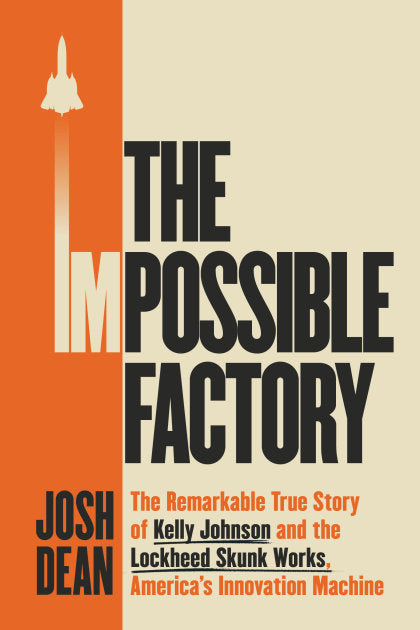
The Impossible Factory
The Impossible Factory
Couldn't load pickup availability
Collapsible content
ABOUT
"A kerosene-soaked masterclass in what extreme innovation looks, feels, and even smells like." —New York Times bestselling author Ashlee Vance
It began with a humble warehouse building in Burbank, California, and a charismatic young engineer named Kelly Johnson. In 1938, Johnson, who was then freshly out of the University of Michigan’s school of engineering, got the idea for a small, agile, disruptive engineering shop—one that could help America’s war machine innovate more quickly. By 1943, with the U.S. now in World War II and desperate for new technology, “Advanced Development Projects”—later nicknamed the “Skunk Works”—was born.
During Johnson’s forty-seven years at Lockheed Martin, the Skunk Works developed at least half a dozen planes that would have been the capstone achievement of anyone else’s career. There was the P-38 Lighting, which outdueled Axis pilots over Europe and the Pacific. The XP-80, America’s first ever fighter jet, which did indeed help the Allies win World War II. The Constellation, the first passenger plane with a pressurized cabin, revolutionized commercial air travel. The U-2 spy plane, which could reach an astonishing altitude of 70,000 feet, enabling it to fly dangerous covert missions in Soviet airspace during the height of the Cold War. And perhaps most famous of all, the A-12/SR-71 Blackbird, one of the most unusual, and iconic, planes ever designed.
But the planes were only part of Kelly Johnson’s legacy. There was also his management style, which would come to shape organizations for decades to come. Under him, the Skunk Works’ structure—flat management, no red tape, extraordinary speed—quickly became the model for nurturing innovation, and eventually would fuel the nimble startups of Silicon Valley. Half a century before Mark Zuckerberg coined the motto “move fast and break things,” Kelly Johnson was living that mantra—and at the same time helping the Department of Defense secure the fate of the free world.
STANDARD, PRIMARY, DM AND VARIANT COVERS
Standard and Primary covers are widely available through general retailers. They often have higher print runs and can be cheaper, especially during sales.
In contrast, Direct Market (DM) and variant covers are primarily sold in comic shops. DM editions tend to have more limited availability and may be more valuable to collectors.
The main differences lie in artwork style, availability, price, and collector appeal. Ultimately, the choice between standard and variant covers depends on personal preference, budget, and individual collecting goals.
PRODUCT TYPES
Comic book enthusiasts have various formats to choose from when collecting their favorite stories.
Here's a brief overview of the main types:
Omnibus
- Large, hardcover collections
- Usually contain complete runs or extensive story arcs
- Typically 800-1000+ pages
- Higher price point, often €100-€150
Oversized Hardcover (OHC)
- Similar dimensions to omnibus, but thinner
- Collect shorter runs or story arcs
- Usually 300-600 pages
- Priced between €30-€50
Hardcover (HC)
- Standard-sized hardcover books
- Collect 6-12 issues typically
- Similar dimensions to single issues, but with a hard cover
- Priced around €25-€35
Trade Paperback (TP)
- Softcover collections
- Standard comic book size
- Usually collect 4-6 issues
- Most affordable option, typically €15-€25
Other Formats
- Absolute Editions: Oversized, deluxe hardcovers (mainly DC Comics)
- Compendiums: Massive paperback collections
- Graphic Novels (OGN/GN): Original stories not previously released as single issues
The choice between these formats often depends on personal preference, budget, and collecting goals. Omnibus and OHC editions offer larger artwork and more content but at a higher price, while TPs provide a more affordable way to collect complete story arcs