

Penguin Publishing Group
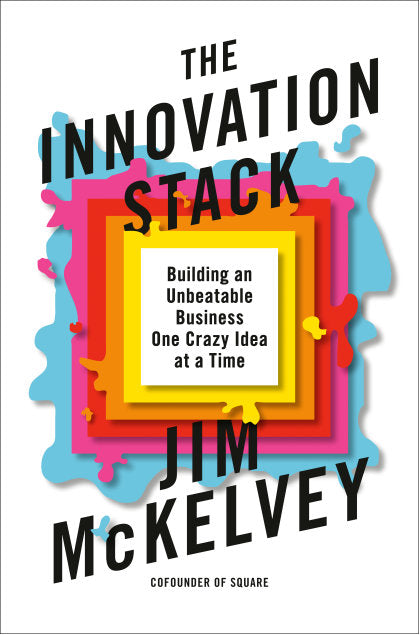
The Innovation Stack
The Innovation Stack
Couldn't load pickup availability
Collapsible content
ABOUT
In 2009, a St. Louis glassblowing artist and recovering computer scientist named Jim McKelvey lost a sale because he couldn't accept American Express cards. Frustrated by the high costs and difficulty of accepting credit card payments, McKelvey joined his friend Jack Dorsey (the cofounder of Twitter) to launch Square, a startup that would enable small merchants to accept credit card payments on their mobile phones. With no expertise or experience in the world of payments, they approached the problem of credit cards with a new perspective, questioning the industry's assumptions, experimenting and innovating their way through early challenges, and achieving widespread adoption from merchants small and large.
But just as Square was taking off, Amazon launched a similar product, marketed it aggressively, and undercut Square on price. For most ordinary startups, this would have spelled the end. Instead, less than a year later, Amazon was in retreat and soon discontinued its service. How did Square beat the most dangerous company on the planet? Was it just luck? These questions motivated McKelvey to study what Square had done differently from all the other companies Amazon had killed. He eventually found the key: a strategy he calls the Innovation Stack.
McKelvey's fascinating and humorous stories of Square's early days are blended with historical examples of other world-changing companies built on the Innovation Stack to reveal a pattern of ground-breaking, competition-proof entrepreneurship that is rare but repeatable.
The Innovation Stack is a thrilling business narrative that's much bigger than the story of Square. It is an irreverent first-person look inside the world of entrepreneurship, and a call to action for all of us to find the entrepreneur within ourselves and identify and fix unsolved problems--one crazy idea at a time.
STANDARD, PRIMARY, DM AND VARIANT COVERS
Standard and Primary covers are widely available through general retailers. They often have higher print runs and can be cheaper, especially during sales.
In contrast, Direct Market (DM) and variant covers are primarily sold in comic shops. DM editions tend to have more limited availability and may be more valuable to collectors.
The main differences lie in artwork style, availability, price, and collector appeal. Ultimately, the choice between standard and variant covers depends on personal preference, budget, and individual collecting goals.
PRODUCT TYPES
Comic book enthusiasts have various formats to choose from when collecting their favorite stories.
Here's a brief overview of the main types:
Omnibus
- Large, hardcover collections
- Usually contain complete runs or extensive story arcs
- Typically 800-1000+ pages
- Higher price point, often €100-€150
Oversized Hardcover (OHC)
- Similar dimensions to omnibus, but thinner
- Collect shorter runs or story arcs
- Usually 300-600 pages
- Priced between €30-€50
Hardcover (HC)
- Standard-sized hardcover books
- Collect 6-12 issues typically
- Similar dimensions to single issues, but with a hard cover
- Priced around €25-€35
Trade Paperback (TP)
- Softcover collections
- Standard comic book size
- Usually collect 4-6 issues
- Most affordable option, typically €15-€25
Other Formats
- Absolute Editions: Oversized, deluxe hardcovers (mainly DC Comics)
- Compendiums: Massive paperback collections
- Graphic Novels (OGN/GN): Original stories not previously released as single issues
The choice between these formats often depends on personal preference, budget, and collecting goals. Omnibus and OHC editions offer larger artwork and more content but at a higher price, while TPs provide a more affordable way to collect complete story arcs