

Penguin Publishing Group
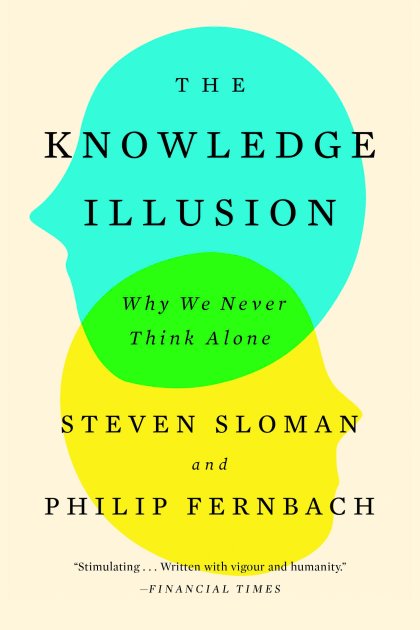
The Knowledge Illusion
The Knowledge Illusion
Couldn't load pickup availability
Collapsible content
ABOUT
We all think we know more than we actually do.
Humans have built hugely complex societies and technologies, but most of us don’t even know how a pen or a toilet works. How have we achieved so much despite understanding so little? Cognitive scientists Steven Sloman and Philip Fernbach argue that we survive and thrive despite our mental shortcomings because we live in a rich community of knowledge. The key to our intelligence lies in the people and things around us. We’re constantly drawing on information and expertise stored outside our heads: in our bodies, our environment, our possessions, and the community with which we interact—and usually we don’t even realize we’re doing it.
The human mind is both brilliant and pathetic. We have mastered fire, created democratic institutions, stood on the moon, and sequenced our genome. And yet each of us is error prone, sometimes irrational, and often ignorant. The fundamentally communal nature of intelligence and knowledge explains why we often assume we know more than we really do, why political opinions and false beliefs are so hard to change, and why individual-oriented approaches to education and management frequently fail. But our collaborative minds also enable us to do amazing things. The Knowledge Illusion contends that true genius can be found in the ways we create intelligence using the community around us.
STANDARD, PRIMARY, DM AND VARIANT COVERS
Standard and Primary covers are widely available through general retailers. They often have higher print runs and can be cheaper, especially during sales.
In contrast, Direct Market (DM) and variant covers are primarily sold in comic shops. DM editions tend to have more limited availability and may be more valuable to collectors.
The main differences lie in artwork style, availability, price, and collector appeal. Ultimately, the choice between standard and variant covers depends on personal preference, budget, and individual collecting goals.
PRODUCT TYPES
Comic book enthusiasts have various formats to choose from when collecting their favorite stories.
Here's a brief overview of the main types:
Omnibus
- Large, hardcover collections
- Usually contain complete runs or extensive story arcs
- Typically 800-1000+ pages
- Higher price point, often €100-€150
Oversized Hardcover (OHC)
- Similar dimensions to omnibus, but thinner
- Collect shorter runs or story arcs
- Usually 300-600 pages
- Priced between €30-€50
Hardcover (HC)
- Standard-sized hardcover books
- Collect 6-12 issues typically
- Similar dimensions to single issues, but with a hard cover
- Priced around €25-€35
Trade Paperback (TP)
- Softcover collections
- Standard comic book size
- Usually collect 4-6 issues
- Most affordable option, typically €15-€25
Other Formats
- Absolute Editions: Oversized, deluxe hardcovers (mainly DC Comics)
- Compendiums: Massive paperback collections
- Graphic Novels (OGN/GN): Original stories not previously released as single issues
The choice between these formats often depends on personal preference, budget, and collecting goals. Omnibus and OHC editions offer larger artwork and more content but at a higher price, while TPs provide a more affordable way to collect complete story arcs