

Knopf Doubleday Publishing Group
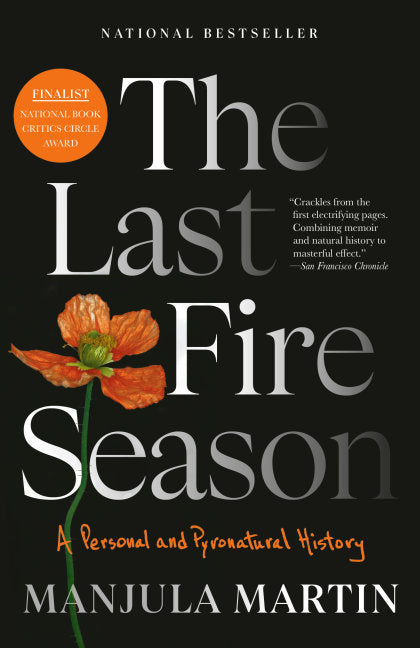
The Last Fire Season
The Last Fire Season
Couldn't load pickup availability
Collapsible content
ABOUT
FINALIST FOR THE NATIONAL BOOK CRITICS CIRCLE AWARD • WINNER OF THE NORTHERN CALIFORNIA BOOK AWARD FOR CREATIVE NONFICTION
NATIONAL BESTSELLER • AN NPR BEST BOOK OF THE YEAR
Told in luminous, perceptive prose, The Last Fire Season is a deeply incisive inquiry into what it really means—now—to live in relationship to the elements of the natural world. When Manjula Martin moved from the city to the woods of Northern California, she wanted to be closer to the wilderness that she had loved as a child. She was also seeking refuge from a health crisis that left her with chronic pain, and found a sense of healing through tending her garden beneath the redwoods of Sonoma County. But the landscape that Martin treasured was an ecosystem already in crisis. Wildfires fueled by climate change were growing bigger and more frequent: each autumn, her garden filled with smoke and ash, and the local firehouse siren wailed deep into the night.
In 2020, when a dry lightning storm ignited hundreds of simultaneous wildfires across the West and kicked off the worst fire season on record, Martin, along with thousands of other Californians, evacuated her home in the midst of a pandemic. Both a love letter to the forests of the West and an interrogation of the colonialist practices that led to their current dilemma, The Last Fire Season, follows her from the oaky hills of Sonoma County to the redwood forests of coastal Santa Cruz, to the pines and peaks of the Sierra Nevada, as she seeks shelter, bears witness to the devastation, and tries to better understand fire’s role in the ecology of the West. As Martin seeks a way to navigate the daily experience of living in a damaged body on a damaged planet, she comes to question her own assumptions about nature and the complicated connections between people and the land on which we live.
STANDARD, PRIMARY, DM AND VARIANT COVERS
Standard and Primary covers are widely available through general retailers. They often have higher print runs and can be cheaper, especially during sales.
In contrast, Direct Market (DM) and variant covers are primarily sold in comic shops. DM editions tend to have more limited availability and may be more valuable to collectors.
The main differences lie in artwork style, availability, price, and collector appeal. Ultimately, the choice between standard and variant covers depends on personal preference, budget, and individual collecting goals.
PRODUCT TYPES
Comic book enthusiasts have various formats to choose from when collecting their favorite stories.
Here's a brief overview of the main types:
Omnibus
- Large, hardcover collections
- Usually contain complete runs or extensive story arcs
- Typically 800-1000+ pages
- Higher price point, often €100-€150
Oversized Hardcover (OHC)
- Similar dimensions to omnibus, but thinner
- Collect shorter runs or story arcs
- Usually 300-600 pages
- Priced between €30-€50
Hardcover (HC)
- Standard-sized hardcover books
- Collect 6-12 issues typically
- Similar dimensions to single issues, but with a hard cover
- Priced around €25-€35
Trade Paperback (TP)
- Softcover collections
- Standard comic book size
- Usually collect 4-6 issues
- Most affordable option, typically €15-€25
Other Formats
- Absolute Editions: Oversized, deluxe hardcovers (mainly DC Comics)
- Compendiums: Massive paperback collections
- Graphic Novels (OGN/GN): Original stories not previously released as single issues
The choice between these formats often depends on personal preference, budget, and collecting goals. Omnibus and OHC editions offer larger artwork and more content but at a higher price, while TPs provide a more affordable way to collect complete story arcs