

Penguin Publishing Group
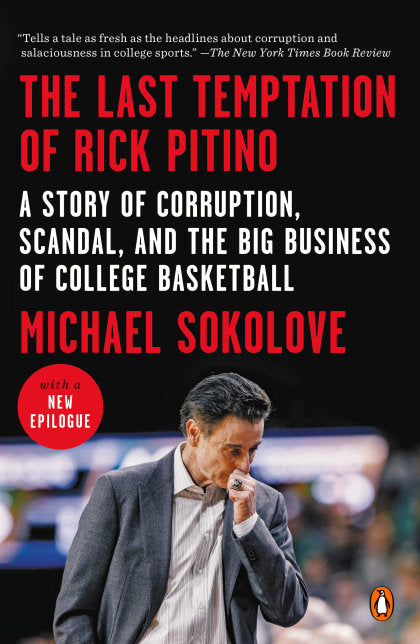
The Last Temptation of Rick Pitino
The Last Temptation of Rick Pitino
Couldn't load pickup availability
Collapsible content
ABOUT
In 2017, the FBI revealed that it had reached the endgame of a sprawling investigation of large-scale corruption involving Adidas, Louisville and a host of other colleges, in which large payments were laundered from Adidas through a network of coaches and fixers to athletes and their families to induce them to go to Adidas-branded college programs. In short order, Hall of Fame basketball coach Rick Pitino (salary: $8 million) and athletic director Tom Jurich were fired, and fear, trembling, and some high-profile litigation swept through the world of bigtime college athletics.
In THE LAST TEMPTATION OF RICK PITINO, Michael Sokolove not only lifts the rug on the Louisville scandal but also places it in the context of the much wider problem, the farce of amateurism in bigtime college sports. In a world in which even assistant coaches can make high-six and seven-figure salaries, as long as they keep the "elite" athletes coming in, shoe deals can reach into the nine figures, and everyone is getting rich but the players, can it be surprising that unscrupulous parties would pay athletes, creating in effect a black market in young men, a veritable underground railroad of talent?
But a few bad apples are one thing. In THE LAST TEMPTATION OF RICK PITINO, Michael Sokolove shows an elaborate, systematic machine, involving hundreds of thousands of dollars in illicit payments and connecting at least one of the largest apparel companies in the world with schools across the country. The Louisville-Adidas scandal has revealed a web of conspiracy whose scope has shaken big-time college sports to its core, delivering a devastating blow to the fantasy of amateurism, of "scholar athletes." A Shakespearean drama of greed and desperation involving some of the biggest characters in the arena of sports, THE LAST TEMPTATION OF RICK PITINO is the definitive chronicle of this scandal and its broader echoes.
STANDARD, PRIMARY, DM AND VARIANT COVERS
Standard and Primary covers are widely available through general retailers. They often have higher print runs and can be cheaper, especially during sales.
In contrast, Direct Market (DM) and variant covers are primarily sold in comic shops. DM editions tend to have more limited availability and may be more valuable to collectors.
The main differences lie in artwork style, availability, price, and collector appeal. Ultimately, the choice between standard and variant covers depends on personal preference, budget, and individual collecting goals.
PRODUCT TYPES
Comic book enthusiasts have various formats to choose from when collecting their favorite stories.
Here's a brief overview of the main types:
Omnibus
- Large, hardcover collections
- Usually contain complete runs or extensive story arcs
- Typically 800-1000+ pages
- Higher price point, often €100-€150
Oversized Hardcover (OHC)
- Similar dimensions to omnibus, but thinner
- Collect shorter runs or story arcs
- Usually 300-600 pages
- Priced between €30-€50
Hardcover (HC)
- Standard-sized hardcover books
- Collect 6-12 issues typically
- Similar dimensions to single issues, but with a hard cover
- Priced around €25-€35
Trade Paperback (TP)
- Softcover collections
- Standard comic book size
- Usually collect 4-6 issues
- Most affordable option, typically €15-€25
Other Formats
- Absolute Editions: Oversized, deluxe hardcovers (mainly DC Comics)
- Compendiums: Massive paperback collections
- Graphic Novels (OGN/GN): Original stories not previously released as single issues
The choice between these formats often depends on personal preference, budget, and collecting goals. Omnibus and OHC editions offer larger artwork and more content but at a higher price, while TPs provide a more affordable way to collect complete story arcs