

Library of America
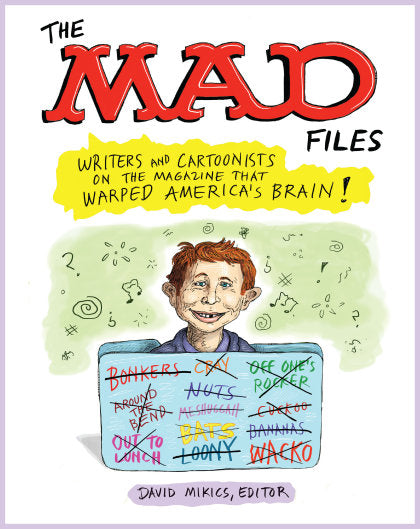
The MAD Files: Writers and Cartoonists on the Magazine that Warped America's Brain!
The MAD Files: Writers and Cartoonists on the Magazine that Warped America's Brain!
Couldn't load pickup availability
Collapsible content
ABOUT
Before SNL and the wise-guy sarcasm of Letterman and Colbert, before The Simpsons and online memes, there was . . . MAD.
A mainstay of countless American childhoods, MAD magazine exploded onto the scene in the 1950s and gleefully thumbed its nose at all the postwar pieties. MAD became the zaniest, most subversive satire magazine ever to be sold on America’s newsstands, anticipating the spirit of underground comix and ’zines and influencing humor writing in movies, television, and the internet to this day.
Edited by David Mikics, The MAD Files celebrates the magazine’s impact and the legacy of the Usual Gang of Idiots who transformed puerile punchlines and merciless mockery into an art form. 26 essays and comics present a varied, perceptive, and often very funny account of MAD’s significance, ranging from the cultural to the aesthetic to the personal.
- Art Spiegelman reflects on how he “couldn’t learn much about America from my refugee immigrant parents—but I learned all about it from MAD”
- Roz Chast remembers how the magazine was “love at first sight. . . . It was one of my first inklings that there were other people out there who found the world as ridiculous as I did.”
- David Hajdu and Grady Hendrix zero in on MAD’s hilarious movie spoofs
- Liel Leibovitz delves into the Jewishness behind the magazine’s humor
- and Rachel Shteir amplifies the often unsung contributions of MAD’s women artists.
Several essays are admiring profiles of the individual creators that made MAD what it was: Mort Drucker, Harvey Kurtzman, Al Jaffee, Antonio Prohias, and Will Elder. For longtime fans and new readers alike, The MAD Files is an indispensable guide to America’s greatest satire magazine.
STANDARD, PRIMARY, DM AND VARIANT COVERS
Standard and Primary covers are widely available through general retailers. They often have higher print runs and can be cheaper, especially during sales.
In contrast, Direct Market (DM) and variant covers are primarily sold in comic shops. DM editions tend to have more limited availability and may be more valuable to collectors.
The main differences lie in artwork style, availability, price, and collector appeal. Ultimately, the choice between standard and variant covers depends on personal preference, budget, and individual collecting goals.
PRODUCT TYPES
Comic book enthusiasts have various formats to choose from when collecting their favorite stories.
Here's a brief overview of the main types:
Omnibus
- Large, hardcover collections
- Usually contain complete runs or extensive story arcs
- Typically 800-1000+ pages
- Higher price point, often €100-€150
Oversized Hardcover (OHC)
- Similar dimensions to omnibus, but thinner
- Collect shorter runs or story arcs
- Usually 300-600 pages
- Priced between €30-€50
Hardcover (HC)
- Standard-sized hardcover books
- Collect 6-12 issues typically
- Similar dimensions to single issues, but with a hard cover
- Priced around €25-€35
Trade Paperback (TP)
- Softcover collections
- Standard comic book size
- Usually collect 4-6 issues
- Most affordable option, typically €15-€25
Other Formats
- Absolute Editions: Oversized, deluxe hardcovers (mainly DC Comics)
- Compendiums: Massive paperback collections
- Graphic Novels (OGN/GN): Original stories not previously released as single issues
The choice between these formats often depends on personal preference, budget, and collecting goals. Omnibus and OHC editions offer larger artwork and more content but at a higher price, while TPs provide a more affordable way to collect complete story arcs