

Penguin Publishing Group
The Man Who Was Thursday
The Man Who Was Thursday
Couldn't load pickup availability
Collapsible content
ABOUT
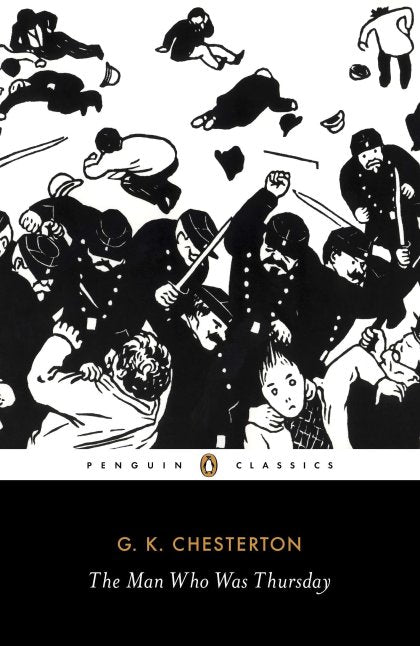
G.K. Chesterton's The Man Who Was Thursday is a thrilling novel of deception, subterfuge, double-crossing and secret identities, and this Penguin Classics edition is edited with an introduction by Matthew Beaumont. The Central Anarchist Council is a secret society sworn to destroy the world. The council is governed by seven men, who hide their identities behind the names of the days of the week. Yet one of their number - Thursday - is not the revolutionary he claims to be, but a Scotland Yard detective named Gabriel Syme, sworn to infiltrate the organisation and bring the architects of chaos to justice. But when he discovers another undercover policeman on the Council, Syme begins to question his role in their operations. And as a desperate chase across Europe begins, his confusion grows, as well as his confidence in his ability to outwit his enemies, unravelling the mysteries of human behaviour and belief in a thrilling contest of wits. But he has still to face the greatest terror that the Council has: a man named Sunday, whose true nature is worse than Syme could ever have imagined ... In his introduction, Matthew Beaumont examines the book's themes of identity and confrontation, and explores its intriguing title. This edition also contains a chronology, notes and suggested further reading. G.K. Chesterton (1874-1938) attended the Slade School of Art, where he appears to have suffered a nervous breakdown, before turning his hand to journalism. A prolific writer throughout his life, his best-known books include The Napoleon of Notting Hill (1904), The Man Who Knew Too Much (1922) and the Father Brown stories. Chesterton converted to Roman Catholicism in 1922 and died in 1938. If you enjoyed The Man Who Was Thursday, you might enjoy Joseph Conrad's The Secret Agent, also available in Penguin Classics. 'The most thrilling book I have ever read' Kingsley Amis, author of Lucky Jim
STANDARD, PRIMARY, DM AND VARIANT COVERS
Standard and Primary covers are widely available through general retailers. They often have higher print runs and can be cheaper, especially during sales.
In contrast, Direct Market (DM) and variant covers are primarily sold in comic shops. DM editions tend to have more limited availability and may be more valuable to collectors.
The main differences lie in artwork style, availability, price, and collector appeal. Ultimately, the choice between standard and variant covers depends on personal preference, budget, and individual collecting goals.
PRODUCT TYPES
Comic book enthusiasts have various formats to choose from when collecting their favorite stories.
Here's a brief overview of the main types:
Omnibus
- Large, hardcover collections
- Usually contain complete runs or extensive story arcs
- Typically 800-1000+ pages
- Higher price point, often €100-€150
Oversized Hardcover (OHC)
- Similar dimensions to omnibus, but thinner
- Collect shorter runs or story arcs
- Usually 300-600 pages
- Priced between €30-€50
Hardcover (HC)
- Standard-sized hardcover books
- Collect 6-12 issues typically
- Similar dimensions to single issues, but with a hard cover
- Priced around €25-€35
Trade Paperback (TP)
- Softcover collections
- Standard comic book size
- Usually collect 4-6 issues
- Most affordable option, typically €15-€25
Other Formats
- Absolute Editions: Oversized, deluxe hardcovers (mainly DC Comics)
- Compendiums: Massive paperback collections
- Graphic Novels (OGN/GN): Original stories not previously released as single issues
The choice between these formats often depends on personal preference, budget, and collecting goals. Omnibus and OHC editions offer larger artwork and more content but at a higher price, while TPs provide a more affordable way to collect complete story arcs