

Penguin Publishing Group
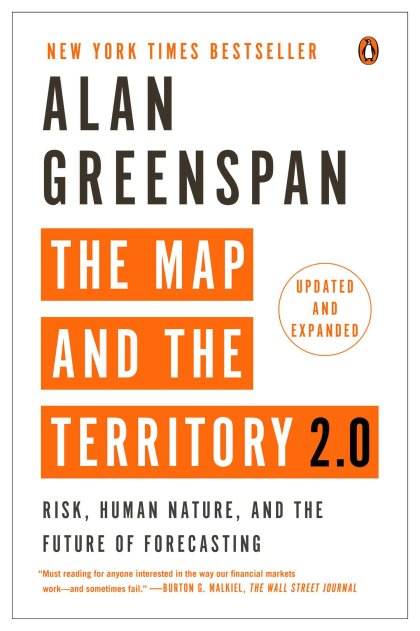
The Map and the Territory 2.0
The Map and the Territory 2.0
Couldn't load pickup availability
Collapsible content
ABOUT
“Must reading for anyone interested in the way our financial markets work – and sometimes fail.” —The Wall Street Journal
Like all of us, though few so visibly, Alan Greenspan was forced by the financial crisis of 2008 to question some fundamental assumptions about risk management and economic forecasting. No one with any meaningful role in economic decision making in the world saw beforehand the storm for what it was. How had our models so utterly failed us? To answer this question, Alan Greenspan embarked on a rigorous and far-reaching multiyear examination of how Homo economicus predicts the economic future, and how it can predict it better. Economic risk is a fact of life in every realm, from home to business to government at all levels. Whether we’re conscious of it or not, we make wagers on the future virtually every day, one way or another. Very often, however, we’re steering by out-of-date maps, when we’re not driven by factors entirely beyond our conscious control.
The Map and the Territory is nothing less than an effort to update our forecasting conceptual grid. It integrates the history of economic prediction, the new work of behavioral economists, and the fruits of the author’s own remarkable career to offer a thrillingly lucid and empirically based grounding in what we can know about economic forecasting and what we can’t. The book explores how culture is and isn't destiny and probes what we can predict about the world's biggest looming challenges, from debt and the reform of the welfare state to natural disasters in an age of global warming.
No map is the territory, but Greenspan’s approach, grounded in his trademark rigor, wisdom, and unprecedented context, ensures that this particular map will assist in safe journeys down many different roads, traveled by individuals, businesses, and the state.
STANDARD, PRIMARY, DM AND VARIANT COVERS
Standard and Primary covers are widely available through general retailers. They often have higher print runs and can be cheaper, especially during sales.
In contrast, Direct Market (DM) and variant covers are primarily sold in comic shops. DM editions tend to have more limited availability and may be more valuable to collectors.
The main differences lie in artwork style, availability, price, and collector appeal. Ultimately, the choice between standard and variant covers depends on personal preference, budget, and individual collecting goals.
PRODUCT TYPES
Comic book enthusiasts have various formats to choose from when collecting their favorite stories.
Here's a brief overview of the main types:
Omnibus
- Large, hardcover collections
- Usually contain complete runs or extensive story arcs
- Typically 800-1000+ pages
- Higher price point, often €100-€150
Oversized Hardcover (OHC)
- Similar dimensions to omnibus, but thinner
- Collect shorter runs or story arcs
- Usually 300-600 pages
- Priced between €30-€50
Hardcover (HC)
- Standard-sized hardcover books
- Collect 6-12 issues typically
- Similar dimensions to single issues, but with a hard cover
- Priced around €25-€35
Trade Paperback (TP)
- Softcover collections
- Standard comic book size
- Usually collect 4-6 issues
- Most affordable option, typically €15-€25
Other Formats
- Absolute Editions: Oversized, deluxe hardcovers (mainly DC Comics)
- Compendiums: Massive paperback collections
- Graphic Novels (OGN/GN): Original stories not previously released as single issues
The choice between these formats often depends on personal preference, budget, and collecting goals. Omnibus and OHC editions offer larger artwork and more content but at a higher price, while TPs provide a more affordable way to collect complete story arcs