

Random House Publishing Group
The Myth of Making It
The Myth of Making It
Couldn't load pickup availability
Collapsible content
ABOUT
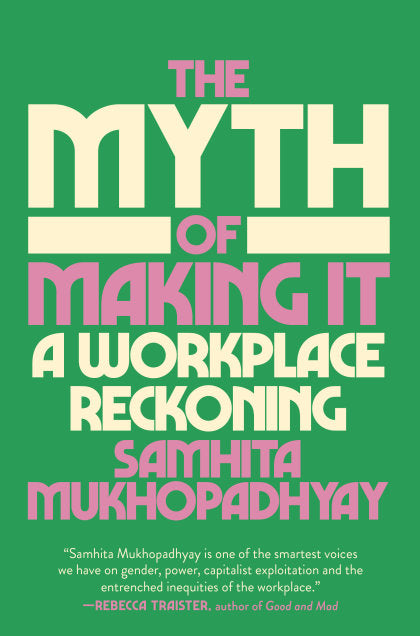
“One of the smartest voices we have on gender, power, capitalist exploitation, and the entrenched inequities of the workplace.”—Rebecca Traister, author of Good and Mad
“As I sat in the front row that day, I was 80 percent faking it with a 100-percent-real Gucci bag.” Samhita Mukhopadhyay had finally made it: she had her dream job, dream clothes—dream life. But time and time again, she found herself sacrificing time with family and friends, paying too much for lattes, and limping home after working twelve hours a day. Success didn’t come without costs, right? Or so she kept telling herself. And Mukhopadhyay wasn’t alone: Far too many of us are taught that we need to work ourselves to the bone to live a good life. That we just need to climb up the corporate ladder, to “lean in” and “hustle,” to enact change. But as Mukhopadhyay shows, these definitions of success are myths—and they are seductive ones.
Mukhopadhyay traces the origins of these myths, taking us from the sixties to the present. She forms a critical overview of workplace feminism, looking at stories from her own professional career, analysis from activists and experts, and of course, experiences of workers at different levels. As more individuals continue to question whether their professional ambitions can lead to happiness and fulfillment in the first place, Mukhopadhyay asks, What would it mean to have a liberated workplace? Mukhopadhyay emerges with a vision for a workplace culture that pays fairly, recognizes our values, and gives people access to the resources they need.
A call to action to redefine and reimagine work as we know it, The Myth of Making It is a field guide and manifesto for all of us who are tired, searching for justice, and longing to be liberated from the oppressive grip of hustle culture.
STANDARD, PRIMARY, DM AND VARIANT COVERS
Standard and Primary covers are widely available through general retailers. They often have higher print runs and can be cheaper, especially during sales.
In contrast, Direct Market (DM) and variant covers are primarily sold in comic shops. DM editions tend to have more limited availability and may be more valuable to collectors.
The main differences lie in artwork style, availability, price, and collector appeal. Ultimately, the choice between standard and variant covers depends on personal preference, budget, and individual collecting goals.
PRODUCT TYPES
Comic book enthusiasts have various formats to choose from when collecting their favorite stories.
Here's a brief overview of the main types:
Omnibus
- Large, hardcover collections
- Usually contain complete runs or extensive story arcs
- Typically 800-1000+ pages
- Higher price point, often €100-€150
Oversized Hardcover (OHC)
- Similar dimensions to omnibus, but thinner
- Collect shorter runs or story arcs
- Usually 300-600 pages
- Priced between €30-€50
Hardcover (HC)
- Standard-sized hardcover books
- Collect 6-12 issues typically
- Similar dimensions to single issues, but with a hard cover
- Priced around €25-€35
Trade Paperback (TP)
- Softcover collections
- Standard comic book size
- Usually collect 4-6 issues
- Most affordable option, typically €15-€25
Other Formats
- Absolute Editions: Oversized, deluxe hardcovers (mainly DC Comics)
- Compendiums: Massive paperback collections
- Graphic Novels (OGN/GN): Original stories not previously released as single issues
The choice between these formats often depends on personal preference, budget, and collecting goals. Omnibus and OHC editions offer larger artwork and more content but at a higher price, while TPs provide a more affordable way to collect complete story arcs