

Random House Publishing Group
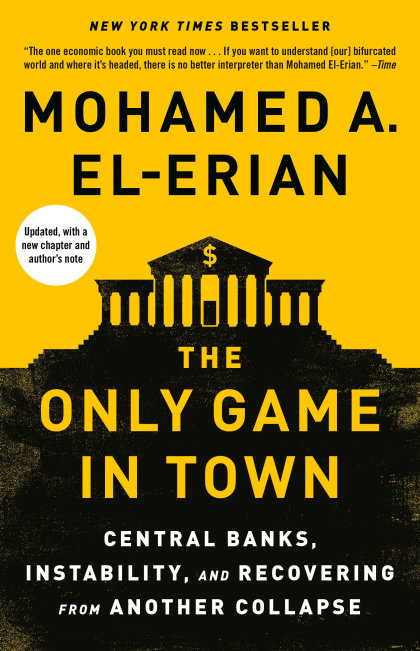
The Only Game in Town
The Only Game in Town
Couldn't load pickup availability
Collapsible content
ABOUT
“The one economic book you must read now . . . If you want to understand [our] bifurcated world and where it’s headed, there is no better interpreter than Mohamed El-Erian.”—Time
Our current economic path is coming to an end. The signposts are all around us: sluggish growth, rising inequality, stubbornly high pockets of unemployment, and jittery financial markets, to name a few. Soon we will reach a fork in the road: One path leads to renewed growth, prosperity, and financial stability, the other to recession and market disorder.
In The Only Game in Town, El-Erian casts his gaze toward the future of the global economy and markets, outlining the choices we face both individually and collectively in an era of economic uncertainty and financial insecurity. Beginning with their response to the 2008 global crisis, El-Erian explains how and why our central banks became the critical policy actors—and, most important, why they cannot continue is this role alone. They saved the financial system from collapse in 2008 and a multiyear economic depression, but lack the tools to enable a return to high inclusive growth and durable financial stability. The time has come for a policy handoff, from a prolonged period of monetary policy experimentation to a strategy that better targets what ails economies and distorts the financial sector—before we stumble into another crisis.
The future, critically, is not predestined. It is up to us to decide where we will go from here as households, investors, companies, and governments. Using a mix of insights from economics, finance, and behavioral science, this book gives us the tools we need to properly understand this turning point, prepare for it, and come out of it stronger. A comprehensive, controversial look at the realities of our global economy and markets, The Only Game in Town is required reading for investors, policymakers, and anyone interested in the future.
STANDARD, PRIMARY, DM AND VARIANT COVERS
Standard and Primary covers are widely available through general retailers. They often have higher print runs and can be cheaper, especially during sales.
In contrast, Direct Market (DM) and variant covers are primarily sold in comic shops. DM editions tend to have more limited availability and may be more valuable to collectors.
The main differences lie in artwork style, availability, price, and collector appeal. Ultimately, the choice between standard and variant covers depends on personal preference, budget, and individual collecting goals.
PRODUCT TYPES
Comic book enthusiasts have various formats to choose from when collecting their favorite stories.
Here's a brief overview of the main types:
Omnibus
- Large, hardcover collections
- Usually contain complete runs or extensive story arcs
- Typically 800-1000+ pages
- Higher price point, often €100-€150
Oversized Hardcover (OHC)
- Similar dimensions to omnibus, but thinner
- Collect shorter runs or story arcs
- Usually 300-600 pages
- Priced between €30-€50
Hardcover (HC)
- Standard-sized hardcover books
- Collect 6-12 issues typically
- Similar dimensions to single issues, but with a hard cover
- Priced around €25-€35
Trade Paperback (TP)
- Softcover collections
- Standard comic book size
- Usually collect 4-6 issues
- Most affordable option, typically €15-€25
Other Formats
- Absolute Editions: Oversized, deluxe hardcovers (mainly DC Comics)
- Compendiums: Massive paperback collections
- Graphic Novels (OGN/GN): Original stories not previously released as single issues
The choice between these formats often depends on personal preference, budget, and collecting goals. Omnibus and OHC editions offer larger artwork and more content but at a higher price, while TPs provide a more affordable way to collect complete story arcs