

Beacon Press
The Patriarchs
The Patriarchs
Couldn't load pickup availability
Collapsible content
ABOUT
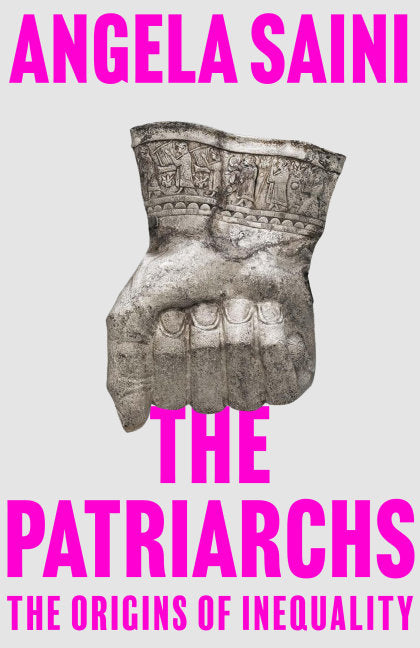
For centuries, societies have treated male domination as natural to the human species. But how would our understanding of gender inequality—our imagined past and contested present— look if we didn’t assume that men have always ruled over women? If we saw inequality as something more fragile that has had to be constantly remade and reasserted?
In this bold and radical book, award-winning science journalist Angela Saini explores the roots of what we call patriarchy, uncovering a complex history of how it first became embedded in societies and spread across the globe from prehistory into the present. She travels to the world’s earliest known human settlements, analyzes the latest research findings in science and archaeology, and traces cultural and political histories from the Americas to Asia, finding that:
- From around 7,000 years ago there are signs that a small number of powerful men were having more children than other men
- From 5,000 years ago, as the earliest states began to expand, gendered codes appeared in parts of Europe, Asia, and the Middle East to serve the interests of powerful elites—but in slow, piecemeal ways, and always resisted
- In societies where women left their own families to live with their husbands, marriage customs came to be informed by the widespread practice of captive-taking and slavery, eventually shaping laws that alienated women from systems of support and denied them equal rights
- There was enormous variation in gender and power in many societies for thousands of years, but colonialism and empire dramatically changed ways of life across Asia, Africa, and the Americas, spreading rigidly patriarchal customs and undermining how people organized their families and work.
In the 19th century and 20th centuries, philosophers, historians, anthropologists, and feminists began to actively question what patriarchy meant as part of the attempt to understand the origins of inequality. In our own time, despite the pushback against sexism, abuse, and discrimination, even revolutionary efforts to bring about equality have often ended in failure and backlash. But The Patriarchs is a profoundly hopeful book—one that reveals a multiplicity to human arrangements that undercuts the old grand narratives and exposes male supremacy as no more (and no less) than an ever-shifting element in systems of control.
STANDARD, PRIMARY, DM AND VARIANT COVERS
Standard and Primary covers are widely available through general retailers. They often have higher print runs and can be cheaper, especially during sales.
In contrast, Direct Market (DM) and variant covers are primarily sold in comic shops. DM editions tend to have more limited availability and may be more valuable to collectors.
The main differences lie in artwork style, availability, price, and collector appeal. Ultimately, the choice between standard and variant covers depends on personal preference, budget, and individual collecting goals.
PRODUCT TYPES
Comic book enthusiasts have various formats to choose from when collecting their favorite stories.
Here's a brief overview of the main types:
Omnibus
- Large, hardcover collections
- Usually contain complete runs or extensive story arcs
- Typically 800-1000+ pages
- Higher price point, often €100-€150
Oversized Hardcover (OHC)
- Similar dimensions to omnibus, but thinner
- Collect shorter runs or story arcs
- Usually 300-600 pages
- Priced between €30-€50
Hardcover (HC)
- Standard-sized hardcover books
- Collect 6-12 issues typically
- Similar dimensions to single issues, but with a hard cover
- Priced around €25-€35
Trade Paperback (TP)
- Softcover collections
- Standard comic book size
- Usually collect 4-6 issues
- Most affordable option, typically €15-€25
Other Formats
- Absolute Editions: Oversized, deluxe hardcovers (mainly DC Comics)
- Compendiums: Massive paperback collections
- Graphic Novels (OGN/GN): Original stories not previously released as single issues
The choice between these formats often depends on personal preference, budget, and collecting goals. Omnibus and OHC editions offer larger artwork and more content but at a higher price, while TPs provide a more affordable way to collect complete story arcs