

Random House Publishing Group
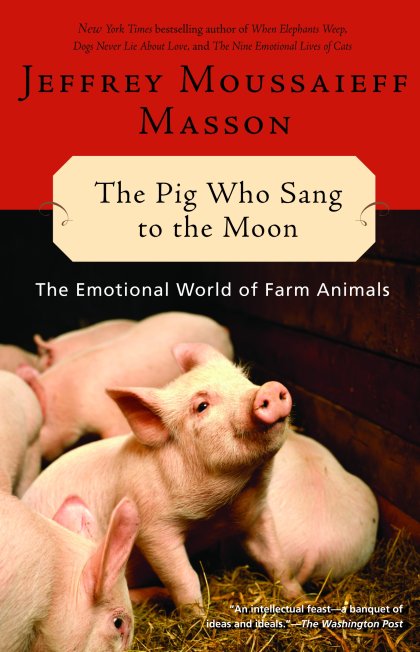
The Pig Who Sang to the Moon
The Pig Who Sang to the Moon
Couldn't load pickup availability
Collapsible content
ABOUT
Weaving history, literature, anecdotes, scientific studies, and Masson’s own vivid experiences observing pigs, cows, sheep, goats, and chickens over the course of five years, this important book at last gives voice, meaning, and dignity to these gentle beasts that are bred to be milked, shorn, butchered, and eaten. Can we ever know what makes an animal happy? Many animal behaviorists say no. But Jeffrey Masson has a different view: An animal is happy if it can live according to its own nature. Farm animals suffer greatly in this regard. Chickens, for instance, like to perch in trees at night, to avoid predators and to nestle with friends. The obvious conclusion: They cannot be happy when confined twenty to a cage.
From field and barn, to pen and coop, Masson bears witness to the emotions and intelligence of these remarkable farm animals, each unique with distinct qualities. Curious, intelligent, self-reliant–many will find it hard to believe that these attributes describe a pig. In fact, there is much that humans share with pigs. They dream, know their names, and can see colors. Mother cows mourn the loss of their calves when their babies are taken away to slaughter. Given a choice between food that is nutritious or lacking in minerals, sheep will select the former, balancing their diet and correcting the deficiency. Goats display quite a sense of humor, dignity, and fearlessness (Indian goats have been known to kill leopards). Chickens are naturally sociable–they will gather around a human companion and stand there serenely preening themselves or sit quietly on the ground beside someone they trust.
For far too long farm animals have been denigrated and treated merely as creatures of instinct rather than as sentient beings. Shattering the abhorrent myth of the “dumb animal without feelings,” Jeffrey Masson has written a revolutionary book that is sure to stir human emotions far and wide.
STANDARD, PRIMARY, DM AND VARIANT COVERS
Standard and Primary covers are widely available through general retailers. They often have higher print runs and can be cheaper, especially during sales.
In contrast, Direct Market (DM) and variant covers are primarily sold in comic shops. DM editions tend to have more limited availability and may be more valuable to collectors.
The main differences lie in artwork style, availability, price, and collector appeal. Ultimately, the choice between standard and variant covers depends on personal preference, budget, and individual collecting goals.
PRODUCT TYPES
Comic book enthusiasts have various formats to choose from when collecting their favorite stories.
Here's a brief overview of the main types:
Omnibus
- Large, hardcover collections
- Usually contain complete runs or extensive story arcs
- Typically 800-1000+ pages
- Higher price point, often €100-€150
Oversized Hardcover (OHC)
- Similar dimensions to omnibus, but thinner
- Collect shorter runs or story arcs
- Usually 300-600 pages
- Priced between €30-€50
Hardcover (HC)
- Standard-sized hardcover books
- Collect 6-12 issues typically
- Similar dimensions to single issues, but with a hard cover
- Priced around €25-€35
Trade Paperback (TP)
- Softcover collections
- Standard comic book size
- Usually collect 4-6 issues
- Most affordable option, typically €15-€25
Other Formats
- Absolute Editions: Oversized, deluxe hardcovers (mainly DC Comics)
- Compendiums: Massive paperback collections
- Graphic Novels (OGN/GN): Original stories not previously released as single issues
The choice between these formats often depends on personal preference, budget, and collecting goals. Omnibus and OHC editions offer larger artwork and more content but at a higher price, while TPs provide a more affordable way to collect complete story arcs