

Penguin Publishing Group
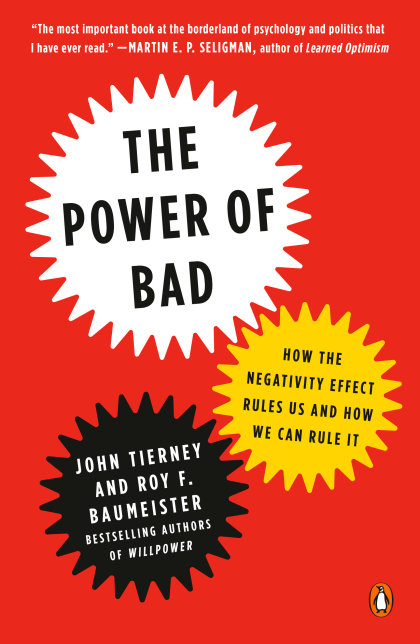
The Power of Bad
The Power of Bad
Couldn't load pickup availability
Collapsible content
ABOUT
Why are we devastated by a word of criticism even when it’s mixed with lavish praise? Because our brains are wired to focus on the bad. This negativity effect explains things great and small: why countries blunder into disastrous wars, why couples divorce, why people flub job interviews, how schools fail students, why football coaches stupidly punt on fourth down. All day long, the power of bad governs people’s moods, drives marketing campaigns, and dominates news and politics.
Eminent social scientist Roy F. Baumeister stumbled unexpectedly upon this fundamental aspect of human nature. To find out why financial losses mattered more to people than financial gains, Baumeister looked for situations in which good events made a bigger impact than bad ones. But his team couldn’t find any. Their research showed that bad is relentlessly stronger than good, and their paper has become one of the most-cited in the scientific literature.
Our brain’s negativity bias makes evolutionary sense because it kept our ancestors alert to fatal dangers, but it distorts our perspective in today’s media environment. The steady barrage of bad news and crisismongering makes us feel helpless and leaves us needlessly fearful and angry. We ignore our many blessings, preferring to heed—and vote for—the voices telling us the world is going to hell.
But once we recognize our negativity bias, the rational brain can overcome the power of bad when it’s harmful and employ that power when it’s beneficial. In fact, bad breaks and bad feelings create the most powerful incentives to become smarter and stronger. Properly understood, bad can be put to perfectly good use.
As noted science journalist John Tierney and Baumeister show in this wide-ranging book, we can adopt proven strategies to avoid the pitfalls that doom relationships, careers, businesses, and nations. Instead of despairing at what’s wrong in your life and in the world, you can see how much is going right—and how to make it still better.
STANDARD, PRIMARY, DM AND VARIANT COVERS
Standard and Primary covers are widely available through general retailers. They often have higher print runs and can be cheaper, especially during sales.
In contrast, Direct Market (DM) and variant covers are primarily sold in comic shops. DM editions tend to have more limited availability and may be more valuable to collectors.
The main differences lie in artwork style, availability, price, and collector appeal. Ultimately, the choice between standard and variant covers depends on personal preference, budget, and individual collecting goals.
PRODUCT TYPES
Comic book enthusiasts have various formats to choose from when collecting their favorite stories.
Here's a brief overview of the main types:
Omnibus
- Large, hardcover collections
- Usually contain complete runs or extensive story arcs
- Typically 800-1000+ pages
- Higher price point, often €100-€150
Oversized Hardcover (OHC)
- Similar dimensions to omnibus, but thinner
- Collect shorter runs or story arcs
- Usually 300-600 pages
- Priced between €30-€50
Hardcover (HC)
- Standard-sized hardcover books
- Collect 6-12 issues typically
- Similar dimensions to single issues, but with a hard cover
- Priced around €25-€35
Trade Paperback (TP)
- Softcover collections
- Standard comic book size
- Usually collect 4-6 issues
- Most affordable option, typically €15-€25
Other Formats
- Absolute Editions: Oversized, deluxe hardcovers (mainly DC Comics)
- Compendiums: Massive paperback collections
- Graphic Novels (OGN/GN): Original stories not previously released as single issues
The choice between these formats often depends on personal preference, budget, and collecting goals. Omnibus and OHC editions offer larger artwork and more content but at a higher price, while TPs provide a more affordable way to collect complete story arcs