

Penguin Publishing Group
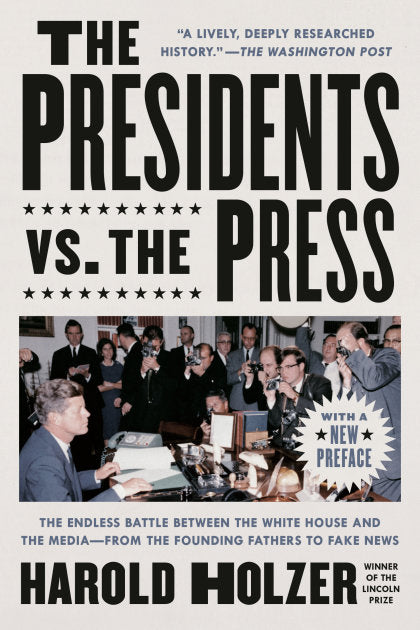
The Presidents vs. the Press
The Presidents vs. the Press
Couldn't load pickup availability
Collapsible content
ABOUT
“The FAKE NEWS media,” Donald Trump has tweeted, “is not my enemy, it is the enemy of the American People!” Has our free press ever faced as great a threat? Perhaps not—but the tension between presidents and journalists is as old as the republic itself.
Every president has been convinced of his own honesty and transparency; every reporter who has covered the White House beat has believed with equal fervency that his or her journalistic rigor protects the country from danger. Our first president, George Washington, was also the first to grouse about his treatment in the newspapers, although he kept his complaints private. Subsequent chiefs like John Adams, Abraham Lincoln, Woodrow Wilson, and Barack Obama were not so reticent, going so far as to wield executive power to overturn press freedoms, and even to prosecute journalists.
Theodore Roosevelt was the first president to actively manage the stable of reporters who followed him, doling out information, steering coverage, and squashing stories that interfered with his agenda. It was a strategy that galvanized TR’s public support, but the lesson was lost on Woodrow Wilson, who never accepted reporters into his inner circle. Franklin Roosevelt transformed media relations forever, holding more than a thousand presidential press conferences and harnessing the new power of radio, at times bypassing the press altogether. John F. Kennedy excelled on television and charmed reporters to hide his personal life, while Richard Nixon was the first to cast the press as a public enemy. From the days of newsprint and pamphlets to the rise of Facebook and Twitter, each president has harnessed the media, whether intentional or not, to imprint his own character on the office.
In this remarkable new history, acclaimed scholar Harold Holzer examines the dual rise of the American presidency and the media that shaped it. From Washington to Trump, he chronicles the disputes and distrust between these core institutions that define the United States of America, revealing that the essence of their confrontation is built into the fabric of the nation.
STANDARD, PRIMARY, DM AND VARIANT COVERS
Standard and Primary covers are widely available through general retailers. They often have higher print runs and can be cheaper, especially during sales.
In contrast, Direct Market (DM) and variant covers are primarily sold in comic shops. DM editions tend to have more limited availability and may be more valuable to collectors.
The main differences lie in artwork style, availability, price, and collector appeal. Ultimately, the choice between standard and variant covers depends on personal preference, budget, and individual collecting goals.
PRODUCT TYPES
Comic book enthusiasts have various formats to choose from when collecting their favorite stories.
Here's a brief overview of the main types:
Omnibus
- Large, hardcover collections
- Usually contain complete runs or extensive story arcs
- Typically 800-1000+ pages
- Higher price point, often €100-€150
Oversized Hardcover (OHC)
- Similar dimensions to omnibus, but thinner
- Collect shorter runs or story arcs
- Usually 300-600 pages
- Priced between €30-€50
Hardcover (HC)
- Standard-sized hardcover books
- Collect 6-12 issues typically
- Similar dimensions to single issues, but with a hard cover
- Priced around €25-€35
Trade Paperback (TP)
- Softcover collections
- Standard comic book size
- Usually collect 4-6 issues
- Most affordable option, typically €15-€25
Other Formats
- Absolute Editions: Oversized, deluxe hardcovers (mainly DC Comics)
- Compendiums: Massive paperback collections
- Graphic Novels (OGN/GN): Original stories not previously released as single issues
The choice between these formats often depends on personal preference, budget, and collecting goals. Omnibus and OHC editions offer larger artwork and more content but at a higher price, while TPs provide a more affordable way to collect complete story arcs