

Beacon Press
The Princess and the Prophet
The Princess and the Prophet
Couldn't load pickup availability
Collapsible content
ABOUT
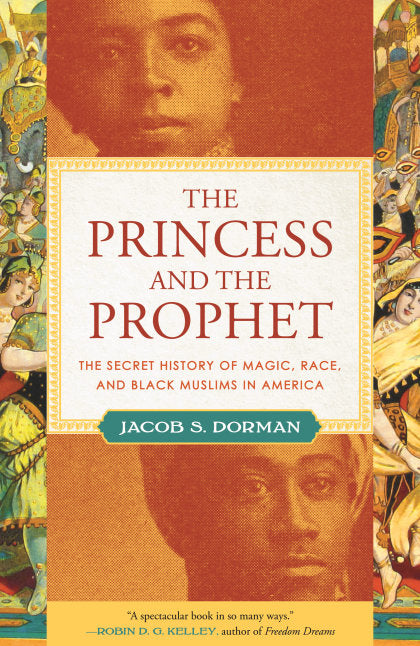
Delving into new archives and uncovering fascinating biographical narratives, secret rituals, and hidden identities, historian Jacob Dorman explains why thousands of Americans were enthralled by the Islamic Orient, and why some came to see Islam as a global antiracist movement uniquely suited to people of African descent in an era of European imperialism, Jim Crow segregation, and officially sanctioned racism.
The Princess and the Prophet tells the story of the Black Broadway performer who, among the world of Arabian acrobats and equestrians, Muslim fakirs, and Wild West shows, discovered in Islam a greater measure of freedom and dignity, and a rebuttal to the racism and parochialism of white America. Overturning the received wisdom that the prophet was born on the East Coast, Dorman has discovered that Noble Drew Ali was born Walter Brister in Kentucky. With the help of his wife, a former lion tamer and “Hindoo” magician herself, Brister renamed himself Prophet Noble Drew Ali and founded the predecessor of the Nation of Islam, the Moorish Science Temple of America, in the 1920s.
With an array of profitable businesses, the “Moors” built a nationwide following of thousands of dues-paying members, swung Chicago elections, and embedded themselves in Chicago’s dominant Republican political machine at the height of Prohibition racketeering, only to see their sect descend into infighting in 1929 that likely claimed the prophet’s life. This fascinating untold story reveals that cultures grow as much from imagination as inheritance, and that breaking down the artificial silos around various racial and religious cultures helps to understand not only America’s hidden past but also its polycultural present.
STANDARD, PRIMARY, DM AND VARIANT COVERS
Standard and Primary covers are widely available through general retailers. They often have higher print runs and can be cheaper, especially during sales.
In contrast, Direct Market (DM) and variant covers are primarily sold in comic shops. DM editions tend to have more limited availability and may be more valuable to collectors.
The main differences lie in artwork style, availability, price, and collector appeal. Ultimately, the choice between standard and variant covers depends on personal preference, budget, and individual collecting goals.
PRODUCT TYPES
Comic book enthusiasts have various formats to choose from when collecting their favorite stories.
Here's a brief overview of the main types:
Omnibus
- Large, hardcover collections
- Usually contain complete runs or extensive story arcs
- Typically 800-1000+ pages
- Higher price point, often €100-€150
Oversized Hardcover (OHC)
- Similar dimensions to omnibus, but thinner
- Collect shorter runs or story arcs
- Usually 300-600 pages
- Priced between €30-€50
Hardcover (HC)
- Standard-sized hardcover books
- Collect 6-12 issues typically
- Similar dimensions to single issues, but with a hard cover
- Priced around €25-€35
Trade Paperback (TP)
- Softcover collections
- Standard comic book size
- Usually collect 4-6 issues
- Most affordable option, typically €15-€25
Other Formats
- Absolute Editions: Oversized, deluxe hardcovers (mainly DC Comics)
- Compendiums: Massive paperback collections
- Graphic Novels (OGN/GN): Original stories not previously released as single issues
The choice between these formats often depends on personal preference, budget, and collecting goals. Omnibus and OHC editions offer larger artwork and more content but at a higher price, while TPs provide a more affordable way to collect complete story arcs