

Knopf Doubleday Publishing Group
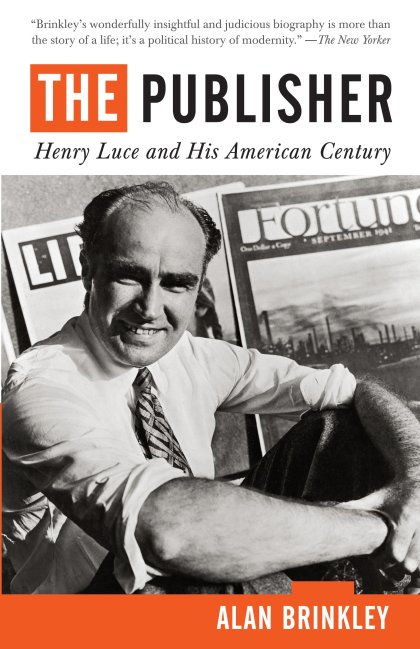
The Publisher
The Publisher
Couldn't load pickup availability
Collapsible content
ABOUT
As the founder of Time, Fortune, and Life magazines, Luce changed the way we consume news and the way we understand our world. Born the son of missionaries, Henry Luce spent his childhood in rural China, yet he glimpsed a milieu of power altogether different at Hotchkiss and later at Yale. While working at a Baltimore newspaper, he and Brit Hadden conceived the idea of Time: a “news-magazine” that would condense the week’s events in a format accessible to increasingly busy members of the middle class. They launched it in 1923, and young Luce quickly became a publishing titan. In 1936, after Time’s unexpected success—and Hadden’s early death—Luce published the first issue of Life, to which millions soon subscribed.
Brinkley shows how Luce reinvented the magazine industry in just a decade. The appeal of Life seemingly cut across the lines of race, class, and gender. Luce himself wielded influence hitherto unknown among journalists. By the early 1940s, he had come to see his magazines as vehicles to advocate for America’s involvement in the escalating international crisis, in the process popularizing the phrase “World War II.” In spite of Luce’s great success, happiness eluded him. His second marriage—to the glamorous playwright, politician, and diplomat Clare Boothe—was a shambles. Luce spent his later years in isolation, consumed at times with conspiracy theories and peculiar vendettas.
The Publisher tells a great American story of spectacular achievement—yet it never loses sight of the public and private costs at which that achievement came.
STANDARD, PRIMARY, DM AND VARIANT COVERS
Standard and Primary covers are widely available through general retailers. They often have higher print runs and can be cheaper, especially during sales.
In contrast, Direct Market (DM) and variant covers are primarily sold in comic shops. DM editions tend to have more limited availability and may be more valuable to collectors.
The main differences lie in artwork style, availability, price, and collector appeal. Ultimately, the choice between standard and variant covers depends on personal preference, budget, and individual collecting goals.
PRODUCT TYPES
Comic book enthusiasts have various formats to choose from when collecting their favorite stories.
Here's a brief overview of the main types:
Omnibus
- Large, hardcover collections
- Usually contain complete runs or extensive story arcs
- Typically 800-1000+ pages
- Higher price point, often €100-€150
Oversized Hardcover (OHC)
- Similar dimensions to omnibus, but thinner
- Collect shorter runs or story arcs
- Usually 300-600 pages
- Priced between €30-€50
Hardcover (HC)
- Standard-sized hardcover books
- Collect 6-12 issues typically
- Similar dimensions to single issues, but with a hard cover
- Priced around €25-€35
Trade Paperback (TP)
- Softcover collections
- Standard comic book size
- Usually collect 4-6 issues
- Most affordable option, typically €15-€25
Other Formats
- Absolute Editions: Oversized, deluxe hardcovers (mainly DC Comics)
- Compendiums: Massive paperback collections
- Graphic Novels (OGN/GN): Original stories not previously released as single issues
The choice between these formats often depends on personal preference, budget, and collecting goals. Omnibus and OHC editions offer larger artwork and more content but at a higher price, while TPs provide a more affordable way to collect complete story arcs