

Penguin Publishing Group
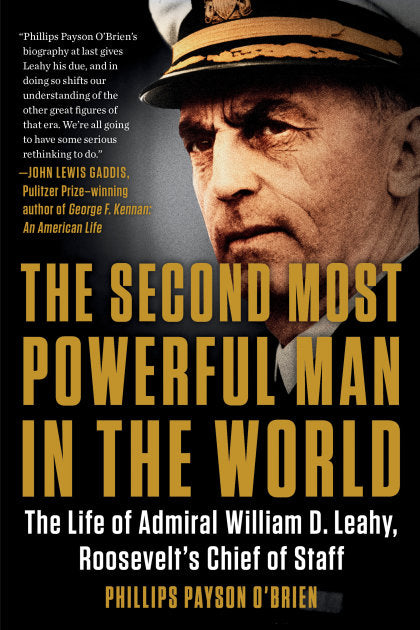
The Second Most Powerful Man in the World
The Second Most Powerful Man in the World
Couldn't load pickup availability
Collapsible content
ABOUT
“O'Brien's biography at last gives Leahy his due.”—John Lewis Gaddis • “Fascinating… greatly enriches our understanding of Washington wartime power.”—Madeleine Albright • “Beautifully written and thoroughly researched.”—Douglas Brinkley • “Transforms our understanding of America's wartime decision-making.”—Hew Strachan
Aside from FDR, no American did more to shape World War II than Admiral William D. Leahy--not Douglas MacArthur, not Dwight Eisenhower, and not even the legendary George Marshall. No man, including Harry Hopkins, was closer to Roosevelt, nor had earned his blind faith, like Leahy. Through the course of the war, constantly at the president's side and advising him on daily decisions, Leahy became the second most powerful man in the world.
In a time of titanic personalities, Leahy regularly downplayed his influence, preferring the substance of power to the style. A stern-faced, salty sailor, his U.S. Navy career had begun as a cadet aboard a sailing ship. Four decades later, Admiral Leahy was a trusted friend and advisor to the president and his ambassador to Vichy France until the attack on Pearl Harbor. Needing one person who could help him grapple with the enormous strategic consequences of the war both at home and abroad, Roosevelt made Leahy the first presidential chief of staff--though Leahy's role embodied far more power than the position of today.
Leahy's profound power was recognized by figures like Stalin and Churchill, yet historians have largely overlooked his role. In this important biography, historian Phillips Payson O'Brien illuminates the admiral's influence on the most crucial and transformative decisions of WWII and the early Cold War. From the invasions of North Africa, Sicily, and France, to the allocation of resources to fight Japan, O'Brien contends that America's war largely unfolded according to Leahy's vision. Among the author's surprising revelations is that while FDR's health failed, Leahy became almost a de facto president, making decisions while FDR was too ill to work, and that much of his influence carried over to Truman's White House.
STANDARD, PRIMARY, DM AND VARIANT COVERS
Standard and Primary covers are widely available through general retailers. They often have higher print runs and can be cheaper, especially during sales.
In contrast, Direct Market (DM) and variant covers are primarily sold in comic shops. DM editions tend to have more limited availability and may be more valuable to collectors.
The main differences lie in artwork style, availability, price, and collector appeal. Ultimately, the choice between standard and variant covers depends on personal preference, budget, and individual collecting goals.
PRODUCT TYPES
Comic book enthusiasts have various formats to choose from when collecting their favorite stories.
Here's a brief overview of the main types:
Omnibus
- Large, hardcover collections
- Usually contain complete runs or extensive story arcs
- Typically 800-1000+ pages
- Higher price point, often €100-€150
Oversized Hardcover (OHC)
- Similar dimensions to omnibus, but thinner
- Collect shorter runs or story arcs
- Usually 300-600 pages
- Priced between €30-€50
Hardcover (HC)
- Standard-sized hardcover books
- Collect 6-12 issues typically
- Similar dimensions to single issues, but with a hard cover
- Priced around €25-€35
Trade Paperback (TP)
- Softcover collections
- Standard comic book size
- Usually collect 4-6 issues
- Most affordable option, typically €15-€25
Other Formats
- Absolute Editions: Oversized, deluxe hardcovers (mainly DC Comics)
- Compendiums: Massive paperback collections
- Graphic Novels (OGN/GN): Original stories not previously released as single issues
The choice between these formats often depends on personal preference, budget, and collecting goals. Omnibus and OHC editions offer larger artwork and more content but at a higher price, while TPs provide a more affordable way to collect complete story arcs