

Berrett-Koehler Publishers
The Sustainable State
The Sustainable State
Couldn't load pickup availability
Collapsible content
ABOUT
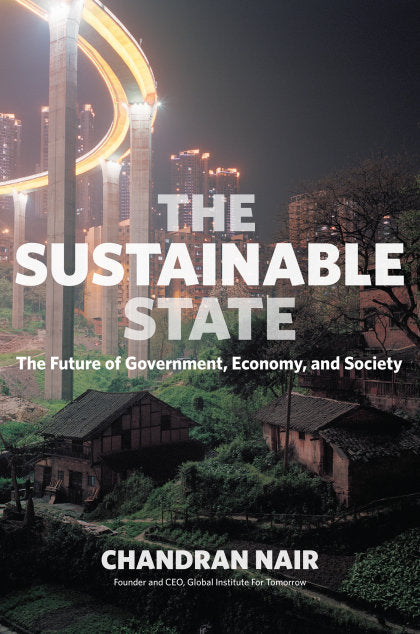
The free-market, limited-government development model has been an ecological and social disaster for the developing world. Sustainable and equitable development is only possible with the active involvement of a strong central state that can guide the economy, protect the environment, and prioritize meeting people’s basic needs.
In this sure-to-be-controversial book, Chandran Nair shows that the market-dominated model followed by the industrialized West is simply not scalable. The US alone, with less than five percent of the world population, consumes nearly a quarter of its resources. If Asian countries, where sixty percent of the world lives, follow the Western lead, the results will be calamitous.
Instead, Nair argues that development must be directed by a state that is willing and able to intervene in the economy. Corporations, which by design demand ever-expanding consumption, need to be directed toward meeting societal needs or otherwise restrained, not unleashed. Development has to be oriented towards the greatest good—clean drinking water for the many has to take precedence over swimming pools for the few. He provides three compelling case studies demonstrating the benefits of such strong state governance and the findings of weak state governance.
This will mean rethinking the meaning of concepts like “prosperity,” “freedom,” and “rights,” and whether democracy is always the best way to ensure responsive government—as Nair writes, “A democracy that cannot work to improve the life of its citizens is not better than a non-democracy that can actually improve quality of life.” Many people will find these to be challenging ideas, but what Nair offers is a model suited to the realities of the developing world, not the assumptions of the dominant culture.
STANDARD, PRIMARY, DM AND VARIANT COVERS
Standard and Primary covers are widely available through general retailers. They often have higher print runs and can be cheaper, especially during sales.
In contrast, Direct Market (DM) and variant covers are primarily sold in comic shops. DM editions tend to have more limited availability and may be more valuable to collectors.
The main differences lie in artwork style, availability, price, and collector appeal. Ultimately, the choice between standard and variant covers depends on personal preference, budget, and individual collecting goals.
PRODUCT TYPES
Comic book enthusiasts have various formats to choose from when collecting their favorite stories.
Here's a brief overview of the main types:
Omnibus
- Large, hardcover collections
- Usually contain complete runs or extensive story arcs
- Typically 800-1000+ pages
- Higher price point, often €100-€150
Oversized Hardcover (OHC)
- Similar dimensions to omnibus, but thinner
- Collect shorter runs or story arcs
- Usually 300-600 pages
- Priced between €30-€50
Hardcover (HC)
- Standard-sized hardcover books
- Collect 6-12 issues typically
- Similar dimensions to single issues, but with a hard cover
- Priced around €25-€35
Trade Paperback (TP)
- Softcover collections
- Standard comic book size
- Usually collect 4-6 issues
- Most affordable option, typically €15-€25
Other Formats
- Absolute Editions: Oversized, deluxe hardcovers (mainly DC Comics)
- Compendiums: Massive paperback collections
- Graphic Novels (OGN/GN): Original stories not previously released as single issues
The choice between these formats often depends on personal preference, budget, and collecting goals. Omnibus and OHC editions offer larger artwork and more content but at a higher price, while TPs provide a more affordable way to collect complete story arcs