

Crown
The Third Miracle
The Third Miracle
Couldn't load pickup availability
Collapsible content
ABOUT
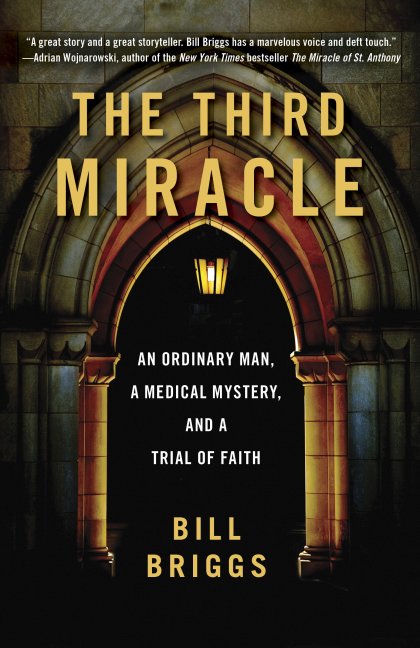
On a raw January 2001 morning at a Catholic convent deep in the Indiana woods, a Baptist handyman named Phil McCord made an urgent plea to God. He was by no means a religious man but he was a desperate man. McCord’s right eye was a furious shade of red and had pulsed for months in the wake of cataract surgery. He had one shot at recovery: a risky procedure that would replace part of his diseased eye with healthy tissue from a corpse. Dreading the grisly operation, McCord stopped into the convent’s chapel and offered a prayer—a spontaneous and fumbling request of God: Can you help me get through this? He merely hoped for inner peace, but when McCord awoke the next day, his eye was better—suddenly and shockingly better. Without surgery. Without medicine. And no doctor could explain it. Many would argue that Mother Théodore Guérin, the long-deceased matriarchal founder of the convent, had “interceded” on McCord’s behalf. Was the healing of Phil McCord’s eye a miracle?
That was a question that the Catholic Church and the pope himself would ultimately decide. As part of an ancient and little-known process, top Catholic officials would convene a confidential tribunal to examine the handyman’s healing, to verify whether his recovery defied the laws of nature. They would formally summon McCord, his doctors, coworkers, and family to a windowless basement room at the Archdiocese of Indianapolis. They would appoint two local priests to serve the roles of judge and prosecutor. And they would put this alleged miracle on trial, all in an effort to determine if Mother Théodore, whose cause for beatification and canonization dated back to 1909, should be named the eighth American saint.
In The Third Miracle, journalist Bill Briggs meticulously chronicles the Church investigation into this mysterious healing and offers a unique window into the ritualistic world of the secretive Catholic saint-making process—one of the very foundations on which the Church is built. With exclusive access to the case and its players, Briggs gives readers a front-row seat inside the closed-door drama as doctors are grilled about the supernatural, priests doggedly hunt for soft spots in the claim, and McCord comes to terms with the metaphorical “third miracle”: his own reconciliation with the metaphysical. As the inquiry shifts from the American heartland to an awaiting jury at Vatican City in Rome, Briggs astutely probes our hunger for everyday miracles in an age of technology, the Catholic Church’s surprisingly active saint-making operation, and the eternal clash of faith and science.
STANDARD, PRIMARY, DM AND VARIANT COVERS
Standard and Primary covers are widely available through general retailers. They often have higher print runs and can be cheaper, especially during sales.
In contrast, Direct Market (DM) and variant covers are primarily sold in comic shops. DM editions tend to have more limited availability and may be more valuable to collectors.
The main differences lie in artwork style, availability, price, and collector appeal. Ultimately, the choice between standard and variant covers depends on personal preference, budget, and individual collecting goals.
PRODUCT TYPES
Comic book enthusiasts have various formats to choose from when collecting their favorite stories.
Here's a brief overview of the main types:
Omnibus
- Large, hardcover collections
- Usually contain complete runs or extensive story arcs
- Typically 800-1000+ pages
- Higher price point, often €100-€150
Oversized Hardcover (OHC)
- Similar dimensions to omnibus, but thinner
- Collect shorter runs or story arcs
- Usually 300-600 pages
- Priced between €30-€50
Hardcover (HC)
- Standard-sized hardcover books
- Collect 6-12 issues typically
- Similar dimensions to single issues, but with a hard cover
- Priced around €25-€35
Trade Paperback (TP)
- Softcover collections
- Standard comic book size
- Usually collect 4-6 issues
- Most affordable option, typically €15-€25
Other Formats
- Absolute Editions: Oversized, deluxe hardcovers (mainly DC Comics)
- Compendiums: Massive paperback collections
- Graphic Novels (OGN/GN): Original stories not previously released as single issues
The choice between these formats often depends on personal preference, budget, and collecting goals. Omnibus and OHC editions offer larger artwork and more content but at a higher price, while TPs provide a more affordable way to collect complete story arcs