

Beacon Press
The Time Lords
The Time Lords
Couldn't load pickup availability
Collapsible content
ABOUT
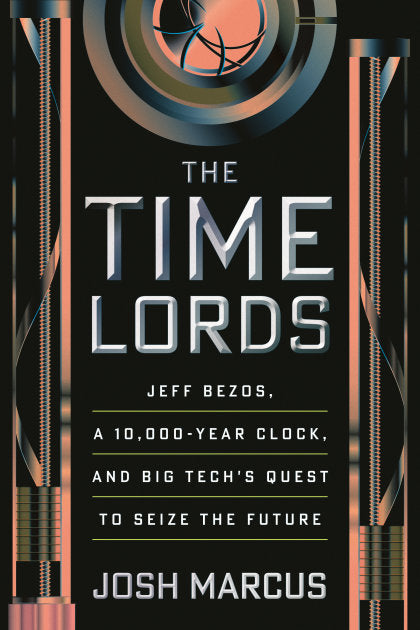
For decades, Amazon founder Jeff Bezos and a legendary group of San Francisco tech execs have been building a hidden world monument: a huge clock, sheltered inside a Texas mountain, designed to tick for 10,000 years.
In the 1990s, a group of tech luminaries — supercomputer designer Danny Hillis, counterculture icon Stewart Brand and eventually Bezos himself — dreamed of creating an iconic symbol to guide us through the coming Internet Age. An eternal clock, far out in the desert, would inspire hope, visionary long-term action and an enduring legend among the pilgrims who searched for it.
But as the monument took shape in a Texas cave, the future seemed to darken. The idealistic tech world that produced the clock – and the extreme wealth of its founders – fueled frightening inequality, mass surveillance and conspiratorial, hate-filled politics online. Against this backdrop, a clock designed to give long-term hope seemed like a cruel joke.
With his vivid style and on the ground reporting, journalist Josh Marcus gives us unconventional history of Jeff Bezos and his contemporaries, and the wider history and influence of the Silicon Valley world they inhabit.
The Time Lords is a time-shifting, vision-altering road trip across the hippie origins of Silicon Valley culture, the workshops of San Francisco and the remote desert of Bezos’s Texas ranch/rocket base. The tale of the clock exposes the glaring contradictions within both Silicon Valley’s attempts to save the world and capitalism itself.
STANDARD, PRIMARY, DM AND VARIANT COVERS
Standard and Primary covers are widely available through general retailers. They often have higher print runs and can be cheaper, especially during sales.
In contrast, Direct Market (DM) and variant covers are primarily sold in comic shops. DM editions tend to have more limited availability and may be more valuable to collectors.
The main differences lie in artwork style, availability, price, and collector appeal. Ultimately, the choice between standard and variant covers depends on personal preference, budget, and individual collecting goals.
PRODUCT TYPES
Comic book enthusiasts have various formats to choose from when collecting their favorite stories.
Here's a brief overview of the main types:
Omnibus
- Large, hardcover collections
- Usually contain complete runs or extensive story arcs
- Typically 800-1000+ pages
- Higher price point, often €100-€150
Oversized Hardcover (OHC)
- Similar dimensions to omnibus, but thinner
- Collect shorter runs or story arcs
- Usually 300-600 pages
- Priced between €30-€50
Hardcover (HC)
- Standard-sized hardcover books
- Collect 6-12 issues typically
- Similar dimensions to single issues, but with a hard cover
- Priced around €25-€35
Trade Paperback (TP)
- Softcover collections
- Standard comic book size
- Usually collect 4-6 issues
- Most affordable option, typically €15-€25
Other Formats
- Absolute Editions: Oversized, deluxe hardcovers (mainly DC Comics)
- Compendiums: Massive paperback collections
- Graphic Novels (OGN/GN): Original stories not previously released as single issues
The choice between these formats often depends on personal preference, budget, and collecting goals. Omnibus and OHC editions offer larger artwork and more content but at a higher price, while TPs provide a more affordable way to collect complete story arcs