

Crown
The Times
The Times
Couldn't load pickup availability
Collapsible content
ABOUT
“An often enthralling chronicle [that] delivers the gossipy goods . . . Like Robert Caro’s biographies, [The Times] should appeal to anyone interested in power.”—Los Angeles Times
A KIRKUS REVIEWS BEST BOOK OF THE YEAR
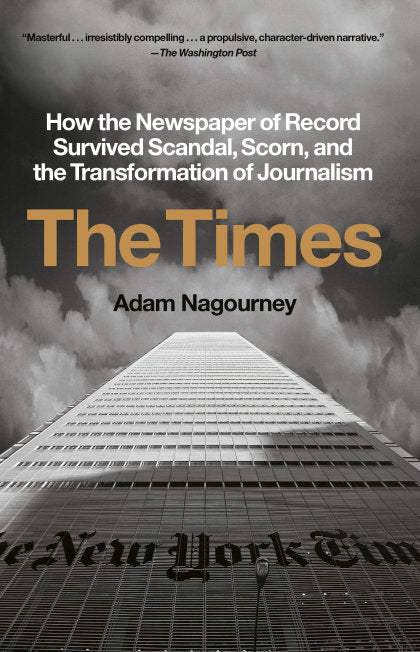
For over a century, The New York Times has been an iconic institution in American journalism, one whose history is intertwined with the events that it chronicles—a newspaper read by millions of people every day to stay informed about events that have taken place across the globe.
In The Times, Adam Nagourney, who’s worked at The New York Times since 1996, examines four decades of the newspaper’s history, from the final years of Arthur “Punch” Sulzberger’s reign as publisher to the election of Donald Trump in November 2016. Nagourney recounts the paper’s triumphs—the coverage of September 11, the explosion of the U.S. Challenger, the scandal of a New York governor snared in a prostitution case—as well as failures that threatened the paper’s standing and reputation, including the discredited coverage of the war in Iraq, the resignation of Judith Miller, the plagiarism scandal of Jayson Blair, and the high-profile ouster of two of its executive editors.
Drawing on hundreds of interviews and thousands of documents and letters contained in the newspaper’s archives and the private papers of editors and reporters, The Times is an inside look at the essential years that shaped the newspaper. Nagourney paints a vivid picture of a divided newsroom, fraught with tension as it struggled to move into the digital age, while confronting its scandals, shortcomings, and swelling criticism from conservatives and many of its own readers alike. Along the way we meet the memorable personalities—including Abe Rosenthal, Max Frankel, Howell Raines, Joe Lelyveld, Bill Keller, Jill Abramson, Dean Baquet, Punch Sulzberger and Arthur Sulzberger Jr.—who shaped the paper as we know it today. We see the battles between the newsroom and the business operations side, the fight between old and new media, the tension between journalists who tried to hold on to the traditional model of a print newspaper and a new generation of reporters who are eager to embrace the new digital world.
Immersive, meticulously researched, and filled with powerful stories of the rise and fall of the men and women who ran the most important newspaper in the nation, The Times is a definitive account of the most pivotal years in New York Times history.
STANDARD, PRIMARY, DM AND VARIANT COVERS
Standard and Primary covers are widely available through general retailers. They often have higher print runs and can be cheaper, especially during sales.
In contrast, Direct Market (DM) and variant covers are primarily sold in comic shops. DM editions tend to have more limited availability and may be more valuable to collectors.
The main differences lie in artwork style, availability, price, and collector appeal. Ultimately, the choice between standard and variant covers depends on personal preference, budget, and individual collecting goals.
PRODUCT TYPES
Comic book enthusiasts have various formats to choose from when collecting their favorite stories.
Here's a brief overview of the main types:
Omnibus
- Large, hardcover collections
- Usually contain complete runs or extensive story arcs
- Typically 800-1000+ pages
- Higher price point, often €100-€150
Oversized Hardcover (OHC)
- Similar dimensions to omnibus, but thinner
- Collect shorter runs or story arcs
- Usually 300-600 pages
- Priced between €30-€50
Hardcover (HC)
- Standard-sized hardcover books
- Collect 6-12 issues typically
- Similar dimensions to single issues, but with a hard cover
- Priced around €25-€35
Trade Paperback (TP)
- Softcover collections
- Standard comic book size
- Usually collect 4-6 issues
- Most affordable option, typically €15-€25
Other Formats
- Absolute Editions: Oversized, deluxe hardcovers (mainly DC Comics)
- Compendiums: Massive paperback collections
- Graphic Novels (OGN/GN): Original stories not previously released as single issues
The choice between these formats often depends on personal preference, budget, and collecting goals. Omnibus and OHC editions offer larger artwork and more content but at a higher price, while TPs provide a more affordable way to collect complete story arcs