

Crown
The Twilight Warriors
The Twilight Warriors
Couldn't load pickup availability
Collapsible content
ABOUT
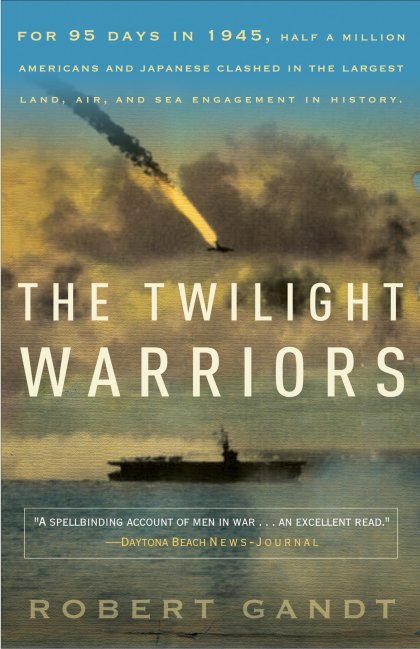
April 1945. The end of World War II finally appears to be nearing. The Third Reich is collapsing in Europe, and the Americans are overpowering the once-mighty Japanese Empire in the Pacific. For a group of young pilots trained in the twilight of the war, their greatest worry is that it will end before they have a chance to face the enemy.
They call themselves Tail End Charlies: They fly at the tail end of formations, stand at the tail end of chow lines, and now they are catching the tail end of the war. What they don’t know is that they will be key players in the bloodiest and most difficult of naval battles—not only of World War II but in all of American history.
The Twilight Warriors relives the drama of the world’s last great naval campaign. From the cockpit of a Corsair fighter we gaze down at the Japanese task force racing to destroy the American amphibious force at Okinawa. Through the eyes of the men on the destroyers assigned to picket ship duty, we experience the terror as wave after wave of kamikazes crash into their ships. Standing on the deck of the legendary superbattleship Yamato, we watch Japan’s last hope for victory die in a tableau of gunfire and explosions.
The fate of the Americans at Okinawa, including a twenty-two-year-old former art student, an intrepid fighter pilot whose life abruptly changes when his Corsair goes down off the enemy shore, and a young Texan lieutenant who volunteers for the most dangerous flying job in the fleet—intercepting kamikazes at night over the blackened Pacific—is intertwined with the lives of the “young gods”: the honor-bound kamikaes forces who swarm like killer bees toward the U.S. ships.
The ferocity of the Okinawa fighting stuns the world. Before it ends, the long battle will cost more American lives, ships, and aircraft than any naval engagement in U.S. history. More than simply the account of a historic battle, The Twilight Warriors brings to life the human side of an epic conflict. It is the story of young Americans at war in the air and on the sea—and of their enigmatic, fanatically courageous enemy.
STANDARD, PRIMARY, DM AND VARIANT COVERS
Standard and Primary covers are widely available through general retailers. They often have higher print runs and can be cheaper, especially during sales.
In contrast, Direct Market (DM) and variant covers are primarily sold in comic shops. DM editions tend to have more limited availability and may be more valuable to collectors.
The main differences lie in artwork style, availability, price, and collector appeal. Ultimately, the choice between standard and variant covers depends on personal preference, budget, and individual collecting goals.
PRODUCT TYPES
Comic book enthusiasts have various formats to choose from when collecting their favorite stories.
Here's a brief overview of the main types:
Omnibus
- Large, hardcover collections
- Usually contain complete runs or extensive story arcs
- Typically 800-1000+ pages
- Higher price point, often €100-€150
Oversized Hardcover (OHC)
- Similar dimensions to omnibus, but thinner
- Collect shorter runs or story arcs
- Usually 300-600 pages
- Priced between €30-€50
Hardcover (HC)
- Standard-sized hardcover books
- Collect 6-12 issues typically
- Similar dimensions to single issues, but with a hard cover
- Priced around €25-€35
Trade Paperback (TP)
- Softcover collections
- Standard comic book size
- Usually collect 4-6 issues
- Most affordable option, typically €15-€25
Other Formats
- Absolute Editions: Oversized, deluxe hardcovers (mainly DC Comics)
- Compendiums: Massive paperback collections
- Graphic Novels (OGN/GN): Original stories not previously released as single issues
The choice between these formats often depends on personal preference, budget, and collecting goals. Omnibus and OHC editions offer larger artwork and more content but at a higher price, while TPs provide a more affordable way to collect complete story arcs