

Harmony/Rodale/Convergent
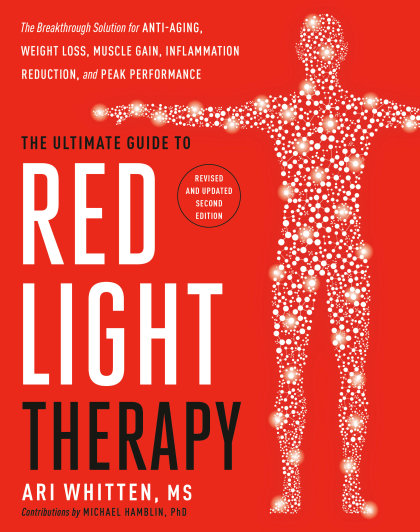
The Ultimate Guide to Red Light Therapy: Revised and Updated
The Ultimate Guide to Red Light Therapy: Revised and Updated
Couldn't load pickup availability
Collapsible content
ABOUT
“Finally, a resource that treats light therapy with the scientific rigor it deserves.”—Dr. Gabrielle Lyon, author of the New York Times bestseller Forever Strong and The Forever Strong Playbook
Light has the power to heal your body and optimize your health. There are over six thousand peer-reviewed scientific studies showing the proven health benefits of red and near-infrared light therapy, also known as photobiomodulation (the science of using light to modulate biology). In The Ultimate Guide to Red Light Therapy, Ari Whitten, MS, cuts through all of the confusion around this complex topic. He explores the science behind this therapy and reveals how to harness its power to improve your health, your body, and your life.
You’ll discover how to
• combat skin aging, wrinkles, and cellulite to look years younger
• accelerate wound and injury healing, reduce pain, and improve joint health
• enhance fat loss and improve overall metabolic health and hormonal health
• support mitochondrial health, overcome fatigue, and improve energy levels
• improve physical performance, amplify the benefits of exercise (increase strength, endurance, and muscle mass), and accelerate exercise recovery
• enhance cognitive function and trigger neuroprotective mechanisms for brain health
• activate systemic anti-aging mechanisms like growth factors and stem cells that enhance cellular regeneration
• fight chronic inflammation, combat hair loss, and improve immune function
But knowing the benefits isn’t enough—you need to know exactly how to get them.
The Ultimate Guide to Red Light Therapy provides critical information on how to achieve the best results—determining the proper dose for every type of treatment, avoiding common mistakes that can undermine your results, and identifying devices that are worth buying while steering clear of those that are underpowered, overpriced, or ineffective.
Optimal light exposure habits are as essential to good health as good nutrition. Red light therapy is one of the biggest health breakthroughs in recent years. It’s time to start using this powerful tool. The Ultimate Guide to Red Light Therapy is your complete road map to transformation through the power of light.
STANDARD, PRIMARY, DM AND VARIANT COVERS
Standard and Primary covers are widely available through general retailers. They often have higher print runs and can be cheaper, especially during sales.
In contrast, Direct Market (DM) and variant covers are primarily sold in comic shops. DM editions tend to have more limited availability and may be more valuable to collectors.
The main differences lie in artwork style, availability, price, and collector appeal. Ultimately, the choice between standard and variant covers depends on personal preference, budget, and individual collecting goals.
PRODUCT TYPES
Comic book enthusiasts have various formats to choose from when collecting their favorite stories.
Here's a brief overview of the main types:
Omnibus
- Large, hardcover collections
- Usually contain complete runs or extensive story arcs
- Typically 800-1000+ pages
- Higher price point, often €100-€150
Oversized Hardcover (OHC)
- Similar dimensions to omnibus, but thinner
- Collect shorter runs or story arcs
- Usually 300-600 pages
- Priced between €30-€50
Hardcover (HC)
- Standard-sized hardcover books
- Collect 6-12 issues typically
- Similar dimensions to single issues, but with a hard cover
- Priced around €25-€35
Trade Paperback (TP)
- Softcover collections
- Standard comic book size
- Usually collect 4-6 issues
- Most affordable option, typically €15-€25
Other Formats
- Absolute Editions: Oversized, deluxe hardcovers (mainly DC Comics)
- Compendiums: Massive paperback collections
- Graphic Novels (OGN/GN): Original stories not previously released as single issues
The choice between these formats often depends on personal preference, budget, and collecting goals. Omnibus and OHC editions offer larger artwork and more content but at a higher price, while TPs provide a more affordable way to collect complete story arcs