

Crown
The Uninhabitable Earth
The Uninhabitable Earth
Couldn't load pickup availability
Collapsible content
ABOUT
With a new afterword
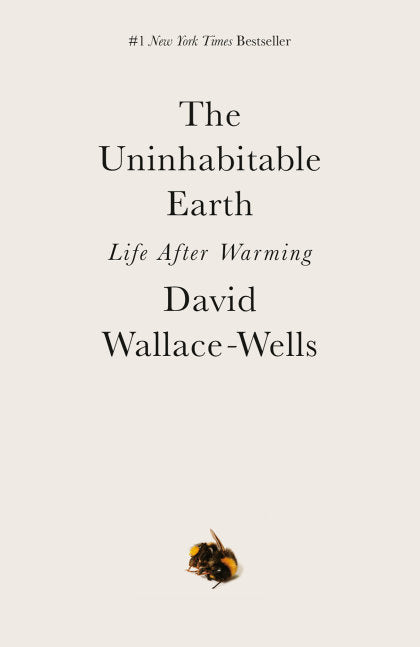
It is worse, much worse, than you think. If your anxiety about global warming is dominated by fears of sea-level rise, you are barely scratching the surface of what terrors are possible—food shortages, refugee emergencies, climate wars and economic devastation.
An “epoch-defining book” (The Guardian) and “this generation’s Silent Spring” (The Washington Post), The Uninhabitable Earth is both a travelogue of the near future and a meditation on how that future will look to those living through it—the ways that warming promises to transform global politics, the meaning of technology and nature in the modern world, the sustainability of capitalism and the trajectory of human progress.
The Uninhabitable Earth is also an impassioned call to action. For just as the world was brought to the brink of catastrophe within the span of a lifetime, the responsibility to avoid it now belongs to a single generation—today’s.
Praise for The Uninhabitable Earth
“The Uninhabitable Earth is the most terrifying book I have ever read. Its subject is climate change, and its method is scientific, but its mode is Old Testament. The book is a meticulously documented, white-knuckled tour through the cascading catastrophes that will soon engulf our warming planet.”—Farhad Manjoo, The New York Times
“Riveting. . . . Some readers will find Mr. Wallace-Wells’s outline of possible futures alarmist. He is indeed alarmed. You should be, too.”—The Economist
“Potent and evocative. . . . Wallace-Wells has resolved to offer something other than the standard narrative of climate change. . . . He avoids the ‘eerily banal language of climatology’ in favor of lush, rolling prose.”—Jennifer Szalai, The New York Times
“The book has potential to be this generation’s Silent Spring.”—The Washington Post
“The Uninhabitable Earth, which has become a best seller, taps into the underlying emotion of the day: fear. . . . I encourage people to read this book.”—Alan Weisman, The New York Review of Books
STANDARD, PRIMARY, DM AND VARIANT COVERS
Standard and Primary covers are widely available through general retailers. They often have higher print runs and can be cheaper, especially during sales.
In contrast, Direct Market (DM) and variant covers are primarily sold in comic shops. DM editions tend to have more limited availability and may be more valuable to collectors.
The main differences lie in artwork style, availability, price, and collector appeal. Ultimately, the choice between standard and variant covers depends on personal preference, budget, and individual collecting goals.
PRODUCT TYPES
Comic book enthusiasts have various formats to choose from when collecting their favorite stories.
Here's a brief overview of the main types:
Omnibus
- Large, hardcover collections
- Usually contain complete runs or extensive story arcs
- Typically 800-1000+ pages
- Higher price point, often €100-€150
Oversized Hardcover (OHC)
- Similar dimensions to omnibus, but thinner
- Collect shorter runs or story arcs
- Usually 300-600 pages
- Priced between €30-€50
Hardcover (HC)
- Standard-sized hardcover books
- Collect 6-12 issues typically
- Similar dimensions to single issues, but with a hard cover
- Priced around €25-€35
Trade Paperback (TP)
- Softcover collections
- Standard comic book size
- Usually collect 4-6 issues
- Most affordable option, typically €15-€25
Other Formats
- Absolute Editions: Oversized, deluxe hardcovers (mainly DC Comics)
- Compendiums: Massive paperback collections
- Graphic Novels (OGN/GN): Original stories not previously released as single issues
The choice between these formats often depends on personal preference, budget, and collecting goals. Omnibus and OHC editions offer larger artwork and more content but at a higher price, while TPs provide a more affordable way to collect complete story arcs